Global Military Focus: Russia and China
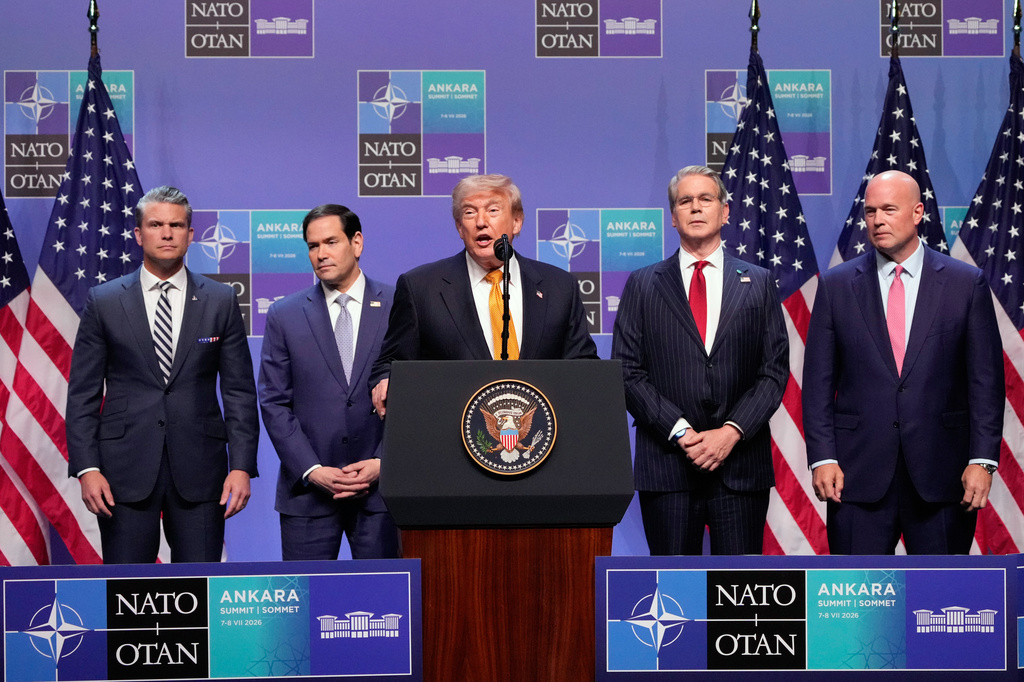
President Donald Trump, accompanied by key members of his administration, addressed the state of global military affairs at the NATO summit in Ankara, Turkey. Standing with Defense Secretary Pete Hegseth, Secretary of State Marco Rubio, Treasury Secretary Scott Bessent, and U.S. Ambassador to NATO Matthew Whitaker, Trump outlined the importance of shifting military resources in anticipation of current conflicts reaching a resolution. He emphasized the necessity for the U.S. to maintain a strategic focus on emerging global threats.
Throughout modern history, Russia has frequently resorted to military force to achieve its political goals. The actions of Russia under Vladimir Putin have highlighted its aggressive foreign policy. From the invasion of Georgia in 2008 to the annexation of Crimea in 2014 and the full-scale invasion of Ukraine, Russia’s intentions have consistently been imperial rather than defensive. The country’s drive to build a war-time economy, endure high casualties, and withstand economic sanctions signifies its determination.
Russia poses a persistent threat, especially to Eastern Europe’s democracies. The Baltic states, Poland, and even NATO itself are under scrutiny. Strong countermeasures are essential, requiring Europe to compensate for the Pentagon’s reduction in forces on the Eastern frontier.
Meanwhile, China, under the Chinese Communist Party, employs a different approach. It uses economic coercion, cyber intrusion, and political influence to expand its reach globally. While China often speaks of reunification with Taiwan, historical patterns show restraint from initiating large-scale military conflicts. Its last major military action outside its borders occurred in 1979, with limited success.
China’s military strategy prioritizes deterrence, information control, and economic leverage. Despite possessing advanced weaponry, China’s military lacks experience in active conflict. The idea that China would suddenly attempt an amphibious invasion of Taiwan contradicts historical patterns and would likely face significant backlash and economic damage.
The U.S. should focus on strengthening alliances in the Indo-Pacific, enhance deterrence measures, and ensure the protection of navigation freedoms. However, strategic focus must also prioritize areas of actual and escalating conflict. Europe has historically been central to Western democracy, and American soldiers have taken significant roles there in past conflicts.
Today, Europe’s security is again under threat. The U.S. must reaffirm its commitment to European security, demonstrating a clear message of unity to adversaries. Russia’s actions are aimed at weakening NATO, exploiting hesitation in Western leadership. To counter this, NATO’s defenses and European command infrastructure must be reinforced and modernized.
Current U.S. military focus orients heavily towards a potential conflict with China, possibly at the expense of immediate needs. American and allied military supplies, crucial for Europe and the Middle East, are depleting, exposing weaknesses in production capabilities. Reinforcing NATO doesn’t detract from Indo-Pacific security—it demonstrates a global commitment to resist aggression.
The U.S. military requires renewed investment in its Army and Air Force. Though the Navy’s presence in the Indo-Pacific is vital, defending Europe depends on land and air superiority, fast logistics, and intelligence sharing. Stability in Europe is pivotal for deterring global conflicts, including those in the Pacific.
As Russia continues to engage in territorial conflict, it challenges global resolve more immediately than China’s ambitions. Addressing Russian aggression through sustained support for European allies can help prevent future strategic challenges. Keith Self, who represents Texas’s 3rd District and serves on the House Foreign Affairs and Veterans’ Affairs committees, emphasizes the importance of these strategic choices. With his military leadership experience, Self underscores that reinforcing Europe will aid in balancing global military priorities.