Home-Based Bakery Triumphs with Unique Pastries
Scottsdale Avenue, situated on Chicago’s southwest edge near Burbank, resembles a typical neighborhood. It’s home to brick houses, two-flats lined with neat yards where children play during the final days of summer. However, weekends bring crowds eager to buy fresh pastries from local home-based bakers.
On a recent Thursday, Samaria Pérez donned a blue apron and began preparing her signature croissant dough. Her baked goods often sell out within hours after she shares an online order link. By Saturday, she expects to box around 500 pastries, each bearing a ‘Samaria’s Kitchen’ sticker, ready for collection.
The kitchen of her licensed micro-bakery parallels a storefront, despite her living room just steps away. Pérez, age 30, owns two commercial ovens and a sizable 40-quart mixer requiring a large whisk or paddle attachment. A separate room, efficiently organized, houses an extra fridge, freezer drawers, rolling racks, bins of flour and sugar, stacks of sheet pans and parchment paper, and an array of baking gadgets.
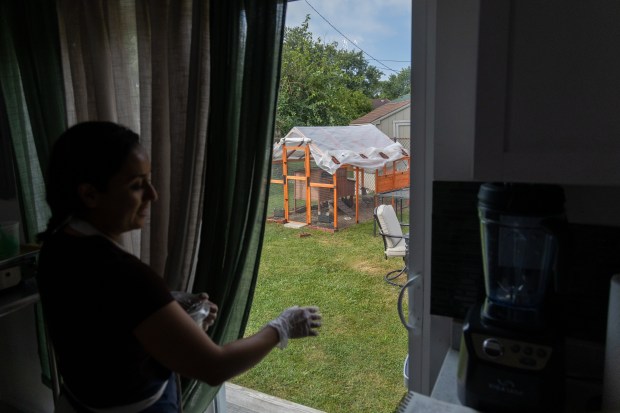
Her backyard features a coop with four chickens. ‘I try to incorporate my chickens’ eggs into recipes, especially curds,’ Pérez explained. ‘The eggs are distinct, and customers often remark on the unique flavor.’
Quality ingredients are crucial to Pérez, who exclusively uses Kerrygold Irish Butter and sources raw honey from local beekeepers. Even her choice of milk at Target is USDA-certified organic, free from growth hormones and banned pesticides. Pérez reflects on her grandmother’s meticulous kitchen in Mexico. ‘She emphasized quality, cleanliness, and using premium ingredients,’ Pérez reminisced.
Launching her business months ago, Pérez has adhered to these principles, resulting in her popular weekly bake sales. Her success highlights the appeal of small-batch producers alongside more established eateries.
This Thursday, Pérez focused on croissants, while her sister and business partner, Arely Pérez, prepared cookies. Golf-ball-sized cookies and cream dough were placed on sheet pans, wrapped, and frozen for Saturday’s fresh baking, ready for the 10 a.m. to 1 p.m. pickup slot.
Increasingly, entrepreneurs pursue small-scale ventures over traditional storefronts. Pérez believes her pastry’s distinct taste will fuel sustained interest. Although she’s cautious with social media, she acknowledges its potential to convey her ingredient choices and engage customers. This strategy could gradually influence the industry.
Pérez has crafted cakes and pastries for friends and family over the years. Before establishing Samaria’s Kitchen in June, she hosted neighborhood bake sale pop-ups, with neighbors equating her creations to popular bakery signatures. Juanita Cano, a neighbor keen on pastries, described Pérez’s offerings as scarce due to word-of-mouth and a devoted customer base.
‘My first taste was a unique olive oil cake, accented with orange and mascarpone frosting,’ Cano recalled. ‘These pastries weren’t easy to get; the demand amazed me.’ In one instance, eager patrons formed lines three houses long in the rain to buy pastries.
Recently, Pérez transitioned to an online system, ensuring production matches orders. Despite a modest Instagram following of 3,000, her audience is built on loyal advocates spreading news of her micro-bakery widely. Videos and posts referencing her pastry sales garner significant attention.
Her pastries’ classification attracted discussion. While some described them as ‘Mexican bread,’ the accuracy faced scrutiny. Pérez, a Mexican baker, clarified that while her pastries incorporate Mexican flavors, they’re not traditional Mexican bread.
Sourdough bread is another popular offer, despite Pérez’s capacity to produce only about 16 loaves weekly. She plans to introduce traditional Mexican sweet bread in time for pan de muerto season; her regular menu spans various categories.
Recent croissant options included pistachio, pecan, chocolate, almond, burnt honey, salted honey-and-orange, and savory rajas con queso variations. Additional baked goods are priced between $3 and $8 each.
‘Control over the dough process sets our croissants apart,’ Pérez shared in explaining her manual dough rolling. She’s particular about butter texture, mimicking quality European butter by incorporating flour for ideal plasticity. Chilled, the butter meets the dough for perfect flaky layers. Preparation spans multiple days, involving thorough folding and laminating.
Pérez, alongside her sister, decides flavors before planning production quantities. Her unperturbed demeanor stems from extensive professional culinary experience. Years spent in renowned kitchens mean she’s accustomed to workload demands and managing her own enterprise is a welcome challenge.
Born near the U.S.-Mexico border in Nuevo Laredo, Pérez relocated to Chicago at age 17 with her family. The transition was marked by language barriers and cultural adjustments.
Originally pursuing law school, Pérez found her passion in culinary arts, enrolling at Robert Morris College for culinary studies. Her commitment to earning a degree and certification paved the way for eventual mastery as a pastry chef.
Pérez continued experimenting with flavors and techniques at home, affirming the benefits of operating a home-based, small-batch bakery. Business experts recognize the increasing trend towards solo ventures facilitated by accessible digital tools.
Professor Sean Higgins from Northwestern University’s Kellogg School emphasized technological advancements lowering the financial barriers to starting such ventures.
‘Comparatively, the lower initial and fail costs appeal to micro-businesses pursuing niche markets,’ Higgins noted, affirming benefits to consumers.
Pérez caters to customers demanding high-quality pastries with local ingredients. Expanding capacity to meet growing demand remains a priority.
Her $20,000 investment created a home bakery equipped with professional appliances. Visible in her Instagram posts, Pérez shares transparent insights into her baking process and ingredient choices, often presenting videos in Spanish with English translations.
‘Honesty is valued in food. Skepticism surrounds home-based endeavors, but I trust the dedication invested in each order,’ Pérez stated. ‘It’s not mass production; each item is crafted specifically for you.’
Thursday’s preparations included incorporating piloncillo, a Mexican brown cane sugar, and Mexican chocolate in her cookie dough. Pérez offers select weekly menus via Hotplate storefront links for direct purchase. Quick sellouts are common.
Saturday morning brings bustling activity; her husband assists in packaging orders while their young son plays. Pérez relishes control over her life and work, moving past typical workplace stresses.
‘Running a home business brings a satisfying balance that’s fulfilling,’ Pérez concluded.