Humanoid Robots Perform Breakthrough Remote Surgery
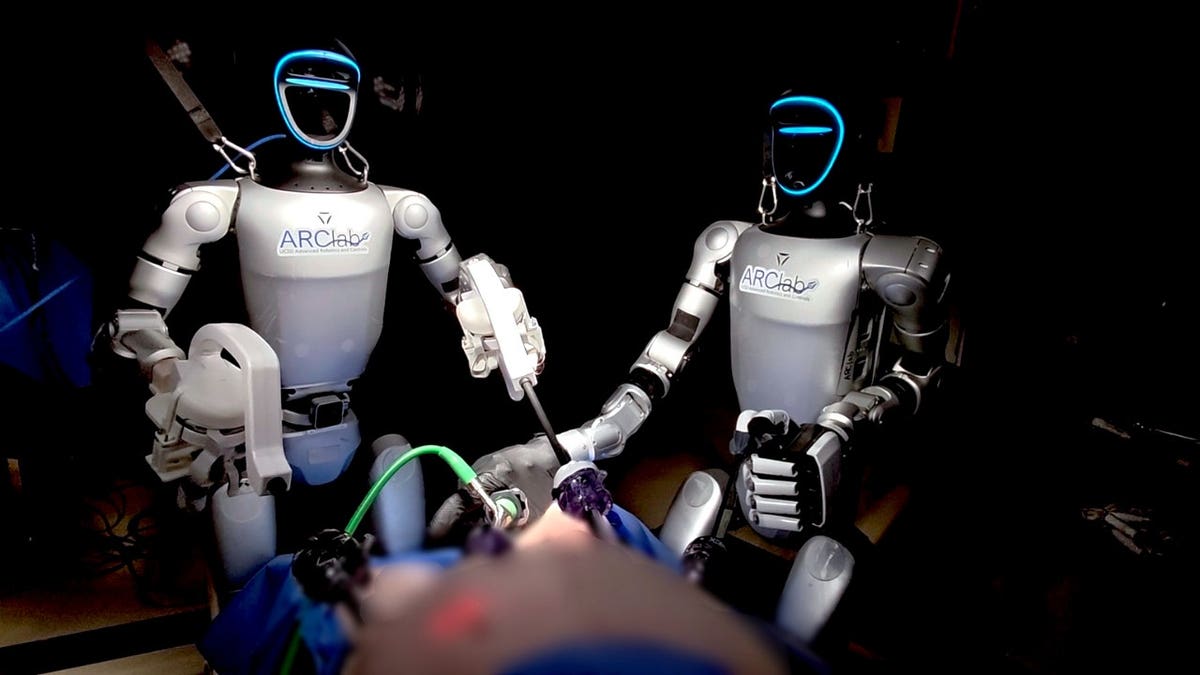
Humanoid robot surgeons are making history with their first remote surgeries. This breakthrough raises concerns about AI privacy. UC San Diego doctors used $20,000 humanoid robots to perform remote gallbladder surgery on a pig. This highlights the potential for AI to address surgeon shortages globally.
For the first time, humanoid robots have completed surgeries. During a preclinical trial, surgeons remotely guided these robots through two gallbladder procedures. The robots mimicked the surgeons’ movements. Human patients were not involved.
Unlike bulky systems, these five-foot robots used standard surgical tools, operating in rooms built for people. The experiment showed how specialists might operate through mobile robots in rural clinics. Here’s what was accomplished and what’s needed before human trials.
Researchers from UC San Diego conducted these surgeries as reported in the journal Nature. In one operation, a humanoid robot handled instruments while a surgeon assisted. In another, two robots worked together, remotely controlled by surgeons. These trials involved delicate tasks in minimally invasive surgeries.
“We were surprised at how well Surgie meshed with our workspace and workflow.” – Nikita Thareja, MD
Researchers created Surgie, modifying commercial humanoid robots, which contrast with the size and setup of surgical robots like Da Vinci systems costing $700,000 to over $3 million. The humanoid robots stand about 5 feet tall and weigh around 60 pounds.
Surgie can operate in standard rooms with adapted hands to grip laparoscopic instruments. A surgeon controlled it remotely, illustrating its human-like design and adaptability to existing operating spaces.
Modern robotic systems allow precise surgeries but stay in one location with specialized equipment. A humanoid robot brings flexibility, operating in spaces built for staff and tools designed for human hands. Remotely operated humanoids could expand access to critical procedures in understaffed areas or field hospitals.
The trial showed potential but involved several recalibrations and longer operation times than typical robotic setups. Latency, the delay between controller movement and robot response, presents challenges. Improvements in reliability and response time are needed before human trials, along with backup plans for system failures.
Currently, human surgeons control the robot’s movements. Researchers aim for autonomous assistants that can perform limited tasks under supervision. However, autonomous surgeries bring challenges in handling emergencies and ensuring safety.
Hospitals need clear accountability rules for each decision and must protect robotic systems from security breaches. The technology’s application is still at the preclinical stage, tested on pigs, not humans.
Though technological advancements show promise, human judgment remains crucial. Before agreeing to robot-assisted procedures, understand the control mechanisms and safety protocols in place.