Marine Le Pen Cleared to Run for French Presidency in 2027 Despite Legal Challenges
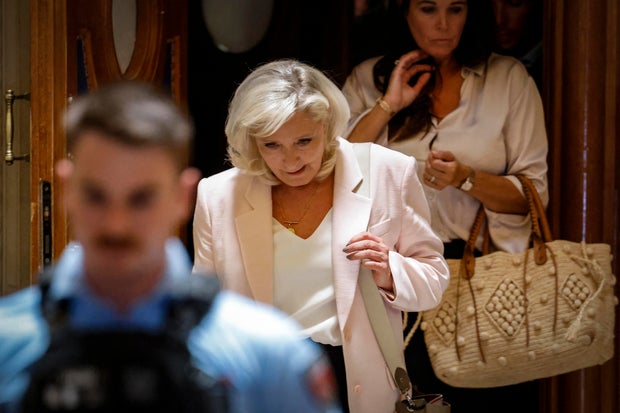
Marine Le Pen has been permitted to stand in the 2027 French presidential election, even though an appeals court upheld a 2025 embezzlement conviction against her. However, her candidacy requires wearing an electronic tag, which she previously stated was “not possible.” She initially faced five years of ineligibility for presidential races, yet the appeals court decreased this to 45 months, with 30 suspended and 15 to be served. Having already complied with the revised restriction, she qualifies to participate in the April 2027 election.
Le Pen has not immediately disclosed her plans for the upcoming election. She was expected to address the public at 8 p.m. local time on Tuesday (2 p.m. Eastern). On July 7, 2026, Marine Le Pen of the National Rally party exited the Paris Court of Appeal following the appeal trial regarding suspected European public funds embezzlement. Her party, formerly known as the National Front, was found guilty in 2025 of diverting EU funds to pay staff members from 2004 to 2016.
Last year, she was ordered to pay over $100,000 in fines and sentenced to four years in prison, with two years suspended and the remaining time under house arrest with an electronic tracking device. The appeals process temporarily suspended the fine and house arrest, but the court reinstated these penalties on Tuesday, reducing the sentence to three years—two suspended, and one under house arrest with a tag.
“If it is a matter of allowing me to run as a candidate while effectively preventing me from campaigning with complete freedom, you will surely understand that that is not possible,” Le Pen said.
Le Pen has stated she would not campaign if restricted by house arrest and the tagging condition. “When you are a presidential candidate, you must be completely free to move about,” she mentioned, emphasizing her need for campaign freedom. Le Pen might request a reduction of her electronic bracelet sentence to six months, which would enable her to campaign freely in the following year.
Her lawyer, Rodolphe Bosselut, expressed partial satisfaction with the verdict, considering it a “good start.” Alongside eight current or former party members, Le Pen faced up to ten years in prison due to the embezzlement scheme. Additionally, a dozen others serving as parliamentary aides for National Rally received guilty findings.
If she were prohibited from running, it was presumed Le Pen would yield her presidential ambitions to her party’s 30-year-old president, Jordan Bardella. According to Adelaide Zulfikarpasic of pollster Ipsos BVA, both Le Pen and Bardella had “similar results in the polls.” They consistently outperformed other parties in early election support surveys, with figures between 31-36%.
The Rise of the French Far-Right
France’s presidential election involves two voting rounds. On April 18, 2027, voters will select from about a dozen party candidates in the first round. The second round, on May 2, will see voters choose one of the top two candidates from the first round.
For years, the so-called Republican Front—an informal alliance of voters from different political groups during the second election round—has prevented far-right candidates from winning. However, Le Pen’s party has been gaining ground in recent times, and many analysts consider it a possible leadership contender next year.
Le Pen reached the second round in 2017 and 2022, a significant shift from when her father, Jean-Marie Le Pen, a convicted antisemite, founded the party in 1972. His initial presidential run yielded just 0.74% of the vote. In 2002, he unexpectedly advanced to the second round against Jacques Chirac.
Ultimately, Jean-Marie Le Pen received less than 18% of the vote, though over five million voted for him. The party re-entered the second round in 2017 when Emmanuel Macron defeated Marine Le Pen by a substantial margin. By the 2022 election, this margin had narrowed to 18%, suggesting the possibility of a 2027 victory for her party.
Macron cannot seek re-election, having served the maximum two terms. “Never, in my memory as a pollster, has the Rassemblement Nationale been measured at such a level at this stage of a presidential election,” noted pollster Zulfikarpasic, reflecting on Le Pen’s party gains.