Military Deployed as Migrants Flock to Ceuta
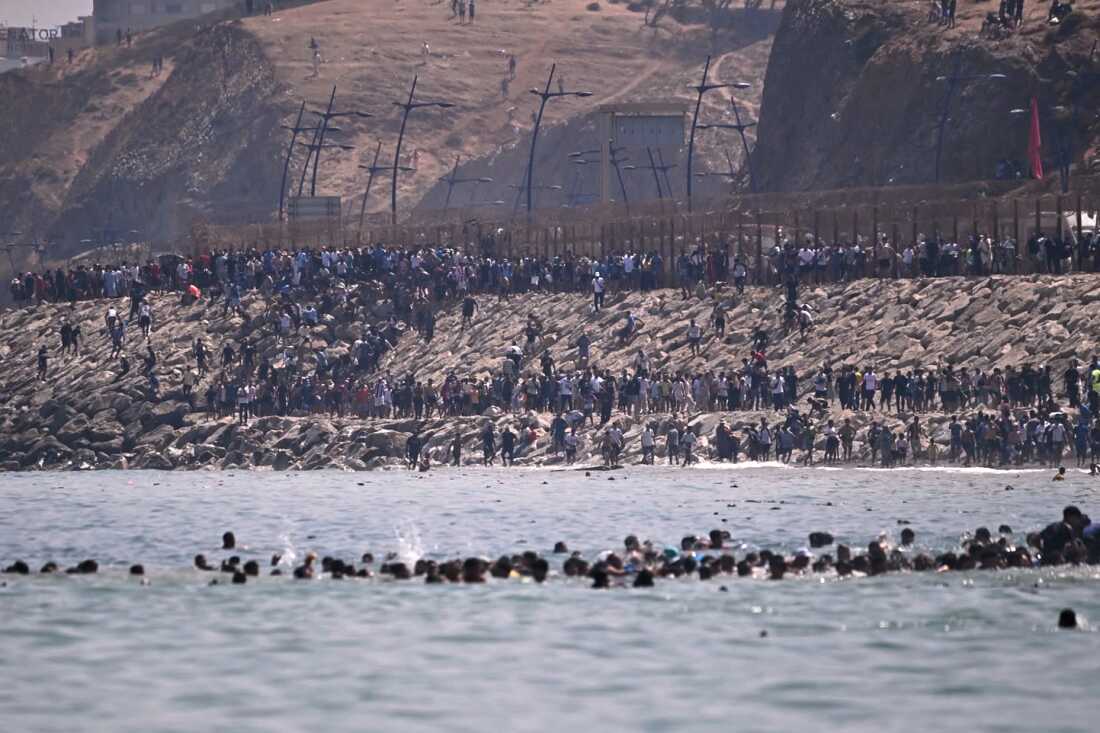
Ceuta, Spain — Spain will deploy its military to maintain order in Ceuta, following an influx of migrants from Morocco. At least nine victims died during the crossings. The chaos erupted Thursday when thousands breached the border fence, prompting Ceuta’s authorities to request reinforcements from Madrid.
The Spanish government promised military support to assist the Civil Guard in ensuring security. Prime Minister Pedro Sánchez and Interior Minister Fernando Grande-Marlaska planned to visit Ceuta on Friday.
Rachid Sbihi, a representative of Spain’s Civil Guard officers in Ceuta, described the situation as total chaos. Thousands of migrants crossed the border, effectively collapsing it.
Achraf Maimouni from the Moroccan Association for Human Rights noted the exceptional circumstances that led to the opening of the Tarajal border, allowing people to enter Spain.
Videos captured migrants, mainly Moroccans, navigating the waters and roads at Tarajal beach. While most were young men, families and children were also present. “Viva España!” echoed from some, addressed by an AP photographer.
The exact motivation behind the crossings remains unclear. Spain’s Ceuta delegation reported nine deaths but did not detail the nature of the fatalities. Bodies were visible in the water, adding to this year’s death toll of dozens attempting to reach Ceuta.
Increasing Migrant Attempts on Ceuta’s Border
The escalation follows a spike in migrants attempting to reach Ceuta, notably by swimming, the day before. Moroccan authorities remained silent, not commenting on the crossings or responding to inquiries.
Spain’s Interior Ministry reported Morocco’s cooperation in controlling the situation. Both nations agreed to encourage the return of those who entered Ceuta illegally.
Despite demands from Ceuta’s officials, Spain decided against declaring a national emergency over the migrant surge. However, political tensions arose in Italy, where Premier Giorgia Meloni considered suspending the Schengen agreement with Spain to maintain border security.
Backdrop of Legal Rulings and Diplomatic Tensions
Ceuta’s sudden spike in arrivals coincided with a Spanish Supreme Court decision preventing immediate deportations of sea-arriving migrants. The ruling does not apply to overland migrants. Activists doubted this legal decision informed the migrants, implying other factors influenced the crossings.
As a key entry point for migrants seeking economic opportunities or escaping violence, Spain, and particularly Ceuta, serve as gateways to Europe. Commonly, migrants swim from Morocco’s Fnideq or Belyounech to cover the 3.1-mile stretch to Spanish territory.
The scenario echoes the May 2021 crisis when Morocco allegedly eased border control, allowing over 8,000 migrants to enter Ceuta over two days. This transpired after Spain treated Brahim Ghali, Polisario Front leader, sparking diplomatic strain with Morocco.
Calls for National Emergency in Ceuta
Juan Jesús Vivas of Ceuta’s regional government urged Madrid for emergency status, citing national security. Beyond police reinforcements, he requested military deployment to uphold border security and citizen safety. The migration wave overwhelmed reception centers, leaving hundreds on the streets.
Spain’s Interior Ministry recorded nearly 3,000 migrant entries into Ceuta, as of July 15. Recent migration reports awaited on Aug. 3, with lack of confirmation on recent numbers.
National emergency protocols exclude migration as a security threat, noted by Spain’s Interior Ministry. Yet, government entities are actively coordinating responses within Ceuta.
Ceuta, with its rich historical roots holds a mixed community of Christians, Muslims, Spanish, and Moroccan residents alongside workers. Despite the border fence, many African migrants risk crossing for European opportunities.