NASA Astronauts Repair International Space Station’s Robotic Arm
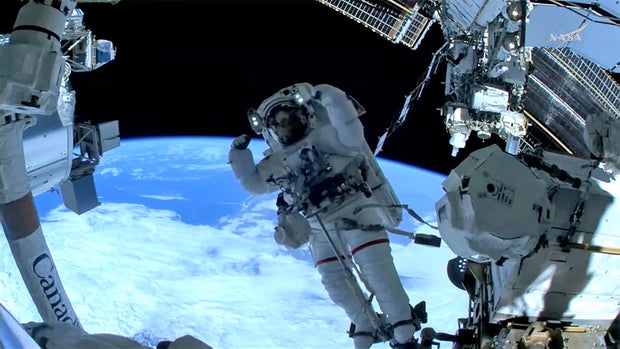
Two NASA astronauts successfully carried out a repair mission outside the International Space Station. They replaced a broken 200-pound wrist joint located near the end of the 58-foot-long robotic arm. The mission control team, led by Canadian astronaut Jenni Gibbons, voiced appreciation, noting the complex nature of the task during the seven-hour and 20-minute spacewalk.
During the excursion, Astronaut Chris Williams demonstrated strength during a break from repairing the arm, which operates 260 miles above Earth. The need for repair was identified by flight controllers at the Johnson Space Center in Houston on May 27. They observed the Canadian-built arm’s joints drawing excessive current and failing to move as expected.
NASA collaborated with the Canadian Space Agency, who supplied the station’s arm, to review telemetry and concluded joint replacement was necessary. Two spares are mounted on an external stowage platform, ready for use. Bill Spetch, ISS operations and integration manager, emphasized Canadarm2’s design for interchangeable components, facilitating maintenance.
Astronaut Jessica Meir, making her fifth spacewalk, joined Chris Williams, on his second, starting the year’s third ISS spacewalk and the 280th overall. They activated their spacesuits’ battery power at 8:20 a.m. ET, signaling the start of operations.
Preparations involved setting foot restraints near the platform and positioning the spare joint. Williams and Meir detached the arm’s hand, known as the latching end effector (LEE), alongside two healthy joints. The 900-pound assembly was mounted on a shelf to facilitate removal of joint No. 5, the defective wrist joint.
After four and a half hours, the replacement joint was successfully installed. Fiona Antkowiak, flight director, detailed the plan to replace the failed joint and reassemble the arm with the LEE cluster back in position. Five and a half hours in, the astronauts reattached the LEE cluster, enabling flight controllers to power up and verify electrical connections.
NASA commentator Sandra Jones announced successful confirmation of the robotic arm’s power and data pathways. The astronauts collected tools, returning to the airlock, with the failed joint intended for repairs on Earth. Once refurbished, it and another joint would be returned to the station for future use.
The robotic arm is indispensable for station operations, crucial for capturing cargo ships and assisting in maintenance. Although NASA plans to retire the ISS by 2030, Spetch assured continued arm maintenance due to its operational importance.
This commitment underpins the arm’s role in facilitating station operations till the end of its service life. “There’s not a time where we say hey, we’re just done repairing the arm,” stated Spetch.