New Images Reveal Sun’s Dynamic Surface in Unprecedented Detail
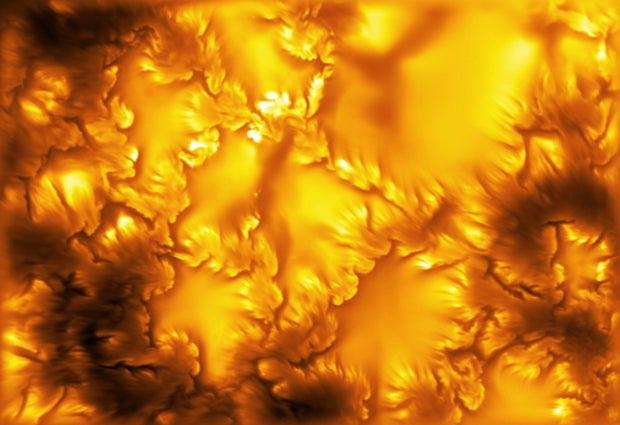
Scientists have achieved the most detailed images of the sun’s surface, unveiling its complex and dynamic exterior. Caution is necessary when observing the sun directly without adequate eye protection. Researchers employed the National Science Foundation’s Daniel K. Inouye Solar Telescope, located in Maui, Hawaii, to safely view the sun’s fiery surface.
The initial purpose of capturing these images was to test and fine-tune the telescope’s capabilities. However, upon reviewing the results, researchers discovered they had photographed the sun’s bright outer layer at an unparalleled resolution. The images also portrayed unusual, feathery patterns traversing the surface.
The images reveal a solar landscape unlike any that had been seen before, uncovering small-scale and dynamic swirls everywhere at the edges of magnetic areas,the NSF’s National Solar Observatory stated in a news release.
Solar physicist Ruizhu Chen from Stanford University, although not involved in the study, compared the patterns to the swirling skies of Van Gogh’s Starry Night. Researchers observed ripples of instability on the solar surface caused by magnetized plasma moving at varying speeds, creating wave-like movements similar to those seen on water under wind influence. This is a known phenomenon called the Kelvin-Helmholtz instability (KHI).
The KHI has been noted on other celestial bodies, such as Jupiter and Saturn. According to study co-author Friedrich Wöger from the National Solar Observatory, it had never been observed at this level on the sun’s surface before. Dr. David Boboltz, deputy director at the National Solar Observatory, highlighted that the discovery represents a significant advancement in understanding the dynamics of solar and stellar plasma.
Published in the journal Nature, the study has piqued scientists’ interest in understanding the sun’s internal mechanisms to better forecast coronal mass ejections—massive bursts of energy that can affect Earth. When these ejections reach Earth, they can trigger solar storms, disrupt GPS communications, and cause spectacular auroras.
Dr. Jacqueline Keane, NSF program director for the National Solar Observatory, stated, To understand the dynamic space weather that affects Earth, we have to see the small-scale processes driving it.
By combining a significant mirror with advanced optics and instruments, the Inouye Solar Telescope provides the resolving power necessary to observe these fine details for the first time, paving the way for new discoveries.