Partial Solar Eclipse Graces Sky in U.S. and Canada
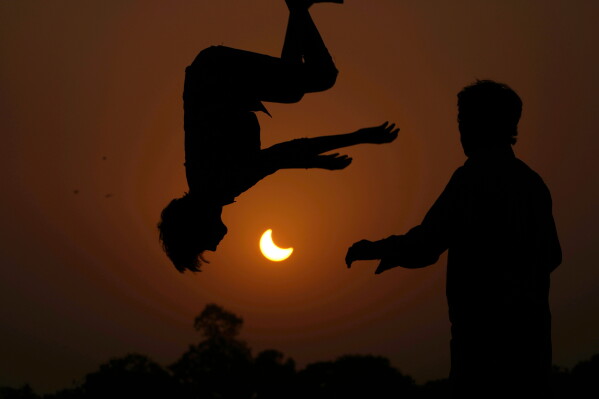
North America recently enjoyed the spectacle of coast-to-coast total solar eclipses. Now, Europe prepares for its chance to observe such a cosmic event. On Wednesday, those in the northern regions of the U.S. and Canada may witness a partial eclipse. During this, the moon appears to take small bites out of the sun.
The path of totality will start near the North Pole, continuing southward. It will pass over Greenland, Iceland, Spain, and some regions of Portugal. Even though the totality will not last beyond a few minutes, marking the first appearance in continental Europe since 1999, it remains a rare occurrence. Spain will see a longer duration of totality next August, along with North Africa and the Middle East.
In the U.S., the Great American Eclipse of 2017 began a fascination with sun eclipses. It included over two minutes of totality, stretching from Oregon to South Carolina. In 2024, a more extensive totality will occur, crossing from Mexico’s Pacific coast and ending past Newfoundland. The next coast-to-coast total eclipse in America is set for 2045. If conditions permit, observing the partial eclipse offers an opportunity to experience a part of this phenomenon. Remember to protect your eyes using certified eclipse glasses.
Viewing Opportunities in U.S. and Canada
Below is a list of U.S. and Canadian cities where you might catch a glimpse of the partial eclipse, provided the skies are clear. The times and coverage percentages are provided by NASA.
- Anchorage, Alaska: 28% coverage. Starts at 7:36 a.m., peaks at 8:21 a.m., ends at 9:09 a.m.
- Bangor, Maine: 24% coverage. Starts at 12:54 p.m., peaks at 1:53 p.m., ends at 2:49 p.m.
- Detroit: 3% coverage. Starts at 1:03 p.m., peaks at 1:36 p.m., ends at 2:08 p.m.
- Montreal, Quebec: 18% coverage. Starts at 12:50 p.m., peaks at 1:45 p.m., ends at 2:38 p.m.
- New York City: 9% coverage. Starts at 1:07 p.m., peaks at 1:54 p.m., ends at 2:38 p.m.
- Philadelphia: 7% coverage. Starts at 1:11 p.m., peaks at 1:53 p.m., ends at 2:35 p.m.
- St. Johns, Newfoundland and Labrador: 53% coverage. Starts at 2:28 p.m., peaks at 3:35 p.m., ends at 4:37 p.m.
- Toronto, Ontario: 8% coverage. Starts at 12:55 p.m., peaks at 1:40 p.m., ends at 2:23 p.m.
- Washington, D.C.: 4% coverage. Starts at 1:17 p.m., peaks at 1:53 p.m., ends at 2:27 p.m.
- Winnipeg, Manitoba: 5% coverage. Starts at 11:25 a.m., peaks at 12:02 p.m., ends at 12:40 p.m.
The Associated Press Health and Science Department credits the Howard Hughes Medical Institute’s Department of Science Education and the Robert Wood Johnson Foundation for support in producing the content.