Pope Leo XIV’s Encyclical on AI and Humanity
Updated on: May 25, 2026 / 11:23 AM EDT / CBS News
Rome — Pope Leo XIV issued a significant document on Monday addressing the impact of artificial intelligence (AI) on humanity. He warned that AI might make civilization “less human.”
Pope Leo, who has had previous conflicts with the Trump administration over the Iran war and the religious justifications for it by some U.S. officials, rejected the notion that the conflict was necessary for American security.
“Today, more than ever, it is vital to reaffirm that the ‘just war’ theory, which has frequently been used to justify wars, is outdated,” he stated in his Magnifica Humanitas (Magnificent Humanity), an 82-page encyclical.
Pope Leo also offered an apology for the Vatican’s involvement in the transatlantic slave trade, acknowledging it as “a wound in Christian memory.” “For this, I sincerely ask for pardon,” he wrote.
However, the primary focus of the encyclical was Leo’s concerns over AI. He cautioned that AI could make civilization “less human,” undermining work, concentrating wealth, and turning people into data-driven systems, rather than preserving human dignity and morality.
“The pressing duty,” Leo asserted, “is to remain profoundly human.”
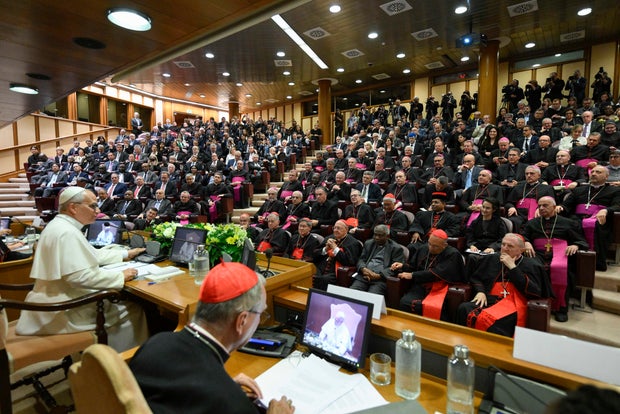
Pope Leo XIV, accompanied by Vatican Secretary of State Cardinal Pietro Parolin, appeared at the presentation of his first Encyclical Letter Magnifica Humanitas at the Synod Hall in Vatican City. The document calls for the “disarming” of AI, noting that technology could drive competition for more powerful algorithms and datasets, motivated by geopolitical or commercial dominance.
This encyclical is the first significant Vatican document created during the era of generative artificial intelligence. It frames the technological revolution not only as an economic challenge but as an “anthropological” one—a crisis affecting the meaning and purpose of humanity.
“The encyclical is not about AI,
Cardinal Michael Czerny, one of the Vatican officials presenting the document, told CBS News.
“It’s about the human condition during the time of AI.”
Using direct language, Leo, who holds a mathematics degree, warned about the increasing power of IT companies, whose influence rivals governments. Nonetheless, he stressed that technology itself is not inherently evil. “Artificial intelligence is a great human achievement,” according to Cardinal Czerny. “But we can’t renounce responsibility.”
The Vatican’s concerns extend beyond Silicon Valley. The encyclical echoes fears that AI could deplete the middle class, eliminate jobs, deepen inequality, and fuel social fragmentation and AI-driven warfare.
“No algorithm can make war morally acceptable,” the encyclical states, as militaries globally integrate AI into their weapon systems.
CBS News witnessed U.S. forces’ exercises in Morocco, noting the growing use of AI-assisted targeting and autonomous systems.
In a notable aspect of the encyclical presentation, Christopher Olah, co-founder of the AI company Anthropic, participated alongside senior church officials. Olah acknowledged that AI companies operate under incentives and constraints that might conflict with ethical decisions, welcoming input from the Catholic Church to steer events positively.
Leo accepted Olah’s invitation “to walk together and discern the major questions of our time,” confident that collaborative efforts could shape humanity’s future.
Anthropic has maintained a “human-first” stance, though it was recently identified by the Trump administration as a supply-chain risk due to its unwillingness to support Pentagon initiatives involving lethal automated systems or mass domestic surveillance.
Its models still integrate into military and intelligence uses, as observed by CBS News. Cardinal Czerny remarked that Anthropic’s human-centered reputation likely influenced the Vatican’s engagement, but emphasized that dialogue with AI firms should not equate to endorsement.
“We dialogue with anyone,” Czerny stated.
The encyclical reiterates that AI’s threats are not solely technological but pose spiritual and existential challenges, potentially causing paralysis.
“We feel overwhelmed and paralyzed,” Cardinal Czerny reported to CBS News.
Asked about AI becoming a substitute for God, Czerny responded affirmatively, cautioning against “idols” emerging.
The pope addressed how the AI revolution is transforming humanity, similar to the shifts in labor and capital during the Industrial Revolution.