Protests and Public Order Challenges in France
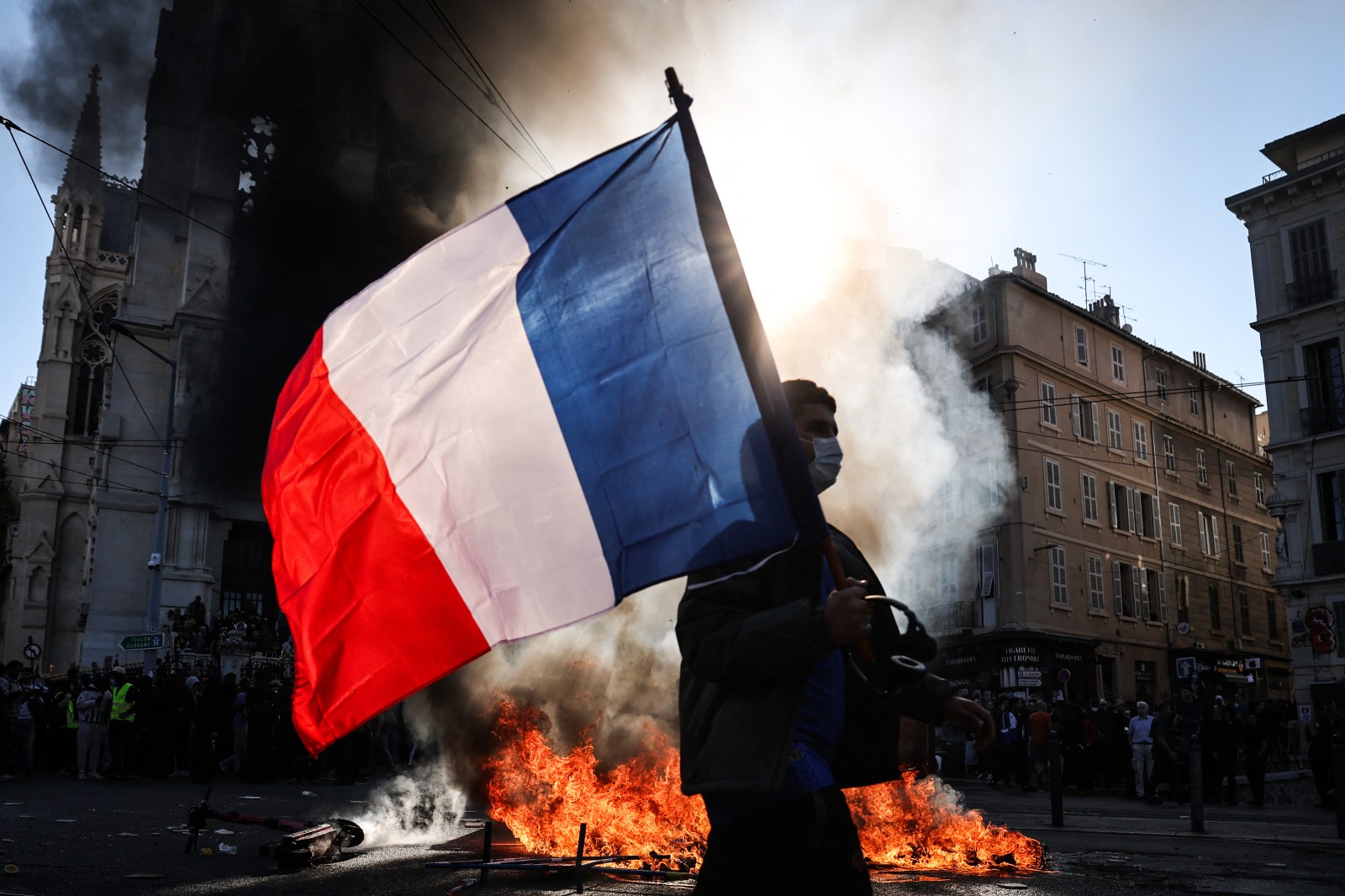
On October 17, over 500,000 French citizens rallied peacefully against the rising cost of living and struggling educational systems. Despite the peaceful beginning, by evening, the town hall in Limoges, which had withstood two world wars, was reduced to a burnt shell. Approximatively 2,400 individuals faced arrest, with around 1,000 police officers and firefighters injured, and about 3,000 businesses looted or damaged. Numerous cars were set ablaze. A demonstration that initiated as a protest escalated into a major public order crisis, posing a critical warning to Western societies.
France has a history of protests, as does Europe generally. However, these current movements have outgrown French borders, prompting a critical question: What consequences arise when radical movements exploit genuine grievances to destabilize the pillars essential for a free society? Such acts impact a society’s trust in its defensive capabilities. France’s government has voiced substantial concerns. Prime Minister Sébastien Lecornu asserted in parliament that far-left factions pursued an “insurrectionary plan,” with security services suggesting networks aimed to incite turmoil leading into the upcoming presidential election. President Emmanuel Macron assigned blame for the assaults on police and public infrastructures to far-left activists. The interior minister acknowledged a loss of institutional control in major cities.
Peaceful protest is a democratic right. Organized radical and Islamist groups utilizing public grievances to challenge law enforcement, dismantle businesses, and destabilize institutions threatens legitimate dissent. It constitutes an intimidation tactic.
Questions arise concerning who finances these disturbances. Recent inquiries into the 54 organizations partaking in the French protests reveal only 16 affiliations with student or youth groups. The others involve political parties, communist and Islamist entities, pro-revolutionary factions, and diverse transnational and domestic advocacy units. Any association between these organizations and ensuing violence warrants evidence. Transparency is paramount for citizens to recognize when organized networks target Western institutions and law enforcement. In contemporary activism, intermediary entities and nonprofits often conceal financial origins.
For instance, tech magnate Neville Roy Singham faces scrutiny over his global political activities possibly linked to the Chinese Communist Party. Singham finances the nonprofit Tricontinental, with its leader, Vijay Prashad, backing the protests publicly. BreakThrough News, related to Singham, also promoted them. These connections do not decisively prove orchestrations of recent violence; nonetheless, they warrant investigation as their influence appears worldwide.
Domestically, the presence of financially strong radical bodies poses consequences. Various progressive global entities have supported harassment against Immigration and Customs Enforcement (ICE) agents and businesses associated with them by financing the Sunrise Movement, known for advocating financial pressure on hotels housing ICE personnel. Those most affected include hotel employees, business proprietors, and everyday Americans striving for livelihood.
While Marxist revolutionaries, Islamists, and regimes opposed to the West may seem distinct, their shared interest in undermining Western institutions and amplifying societal divisions calls for scrutiny and legal action. The Trump administration has depicted this challenge as key to civilization. During a speech in Athens on October 7, Secretary of State Marco Rubio invoked “thumos,” a Greek term embodying passion, strength, and courage, cautioning that nations lacking it lose the will to “fight, strive, survive.” In the Munich Security Conference in February, he also warned against “civilizational erasure.” Vice President JD Vance echoed the sentiment, emphasizing the importance of enforcing laws and securing borders.
The State Department, in November 2025, classified four European far-left organizations as foreign terrorist factions. Americans, however, need not look overseas for a preview. The 2020 summer in the United States, saw organized riots sweeping cities, with burning police precincts, destroyed small businesses, and communities suffering enduring harm. Many businesses belonged to individuals whose interests protesters claimed to champion, illustrating how rapidly order decays when violence is unchecked.
The Americans’ choice surrounds sustaining a thriving civil society contrasted with allowing extremism and intimidation to degrade it. This requires transparent political financing, law enforcement, safeguarding peaceful protests, and ensuring violence accountability. Socialism and radical extremism exploit individuals as movement means. Thus, a shopkeeper’s livelihood or a hotel employee’s wage becomes an acceptable price for power. However, America First champions the citizen, not the cause.
E Pluribus Unum, more than a motto, signifies a mutual commitment to a country where free individuals can work, raise families, practice religion, thrive, and disagree without mob rule fear. France’s riots act as a warning. Civilizational collapse does not occur suddenly; it manifests when leaders permit chaos, institutions retreat, and citizens lose the will to safeguard lasting achievements. A choice as to our future is imminent—a deteriorated, dysfunctional civil society intimidated, or a course towards greatness emphasizing civilizational thumos. The choice is clear
Chad Wolf serves as the chair of Homeland Security and Immigration Policy and chair of the Western Hemisphere Initiative at AFPI. He is the former acting secretary of the U.S. Department of Homeland Security under President Donald Trump. The views expressed herein are his own.