Reviving Antoni Gaudí’s Envisioned New York Skyscraper
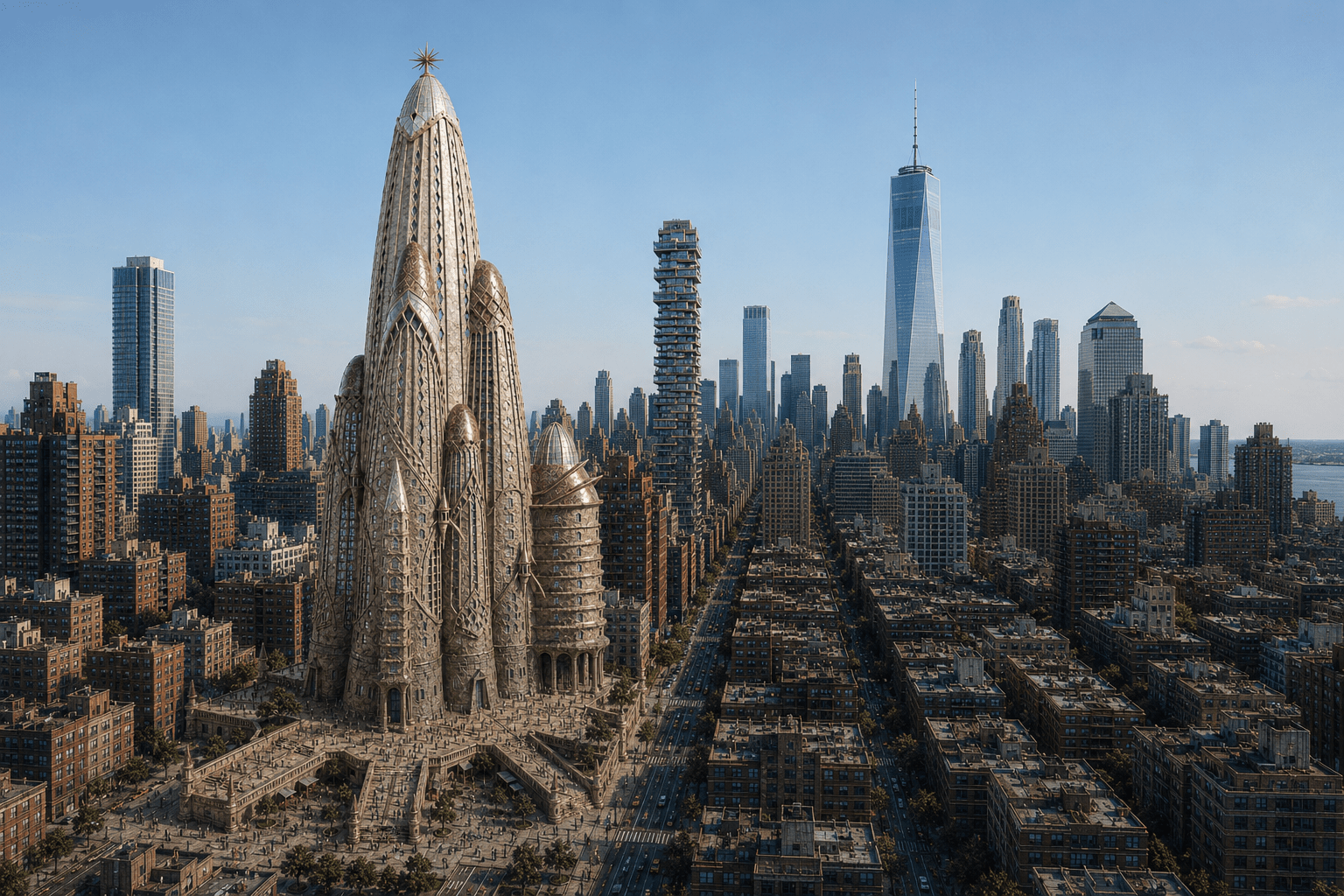
A New York skyscraper, imagined by Antoni Gaudí over a century ago, has been brought to life through detailed visualizations. These renderings showcase both its unique facade and surreal interiors, revealing a structure that might have stood as one of the world’s most extraordinary buildings.
Journalist and architectural enthusiast, Daniel Coughlin, has reimagined Hotel Attraction, an unbuilt tower in Manhattan reportedly commissioned in 1908 by two unknown American businessmen for Gaudí. Hotel Attraction is part of several unrealized urban projects recreated by Coughlin on his YouTube channel, The Curious Compendium of Architectural What-Ifs. While past depictions focused on the exterior, Coughlin’s latest work dives into the ceremony halls, themed cultural spaces, and monumental chambers intended inside.
If constructed, the massive structure would have risen approximately 1,181 feet over Lower Manhattan, making it the tallest building in the world until the Empire State Building’s completion in the 1930s.
The renewed focus on Hotel Attraction coincides with the centenary of Gaudí’s passing. Gaudí died on June 10, 1926, and construction continues on his famed Sagrada Família in Barcelona, over 140 years after building began in 1882. Earlier this year, the church added the upper arm of a cross to the Jesus Christ tower, raising the structure to 565 feet, 11 inches.
“I wanted to explore what Hotel Attraction might have looked and felt like standing in present-day Lower Manhattan,” Coughlin shared with Newsweek. “The interiors were especially compelling as they showed it was meant to be more than a conventional luxury hotel.”
Surviving descriptions reviewed by Coughlin indicate visitors would enter through one of four monumental entrances into a lavishly decorated reception hall approximately 56 feet high. Like the exterior, it would feature trencadís, Gaudí’s signature ceramic mosaic.
Above the reception, themed spaces reflected various global regions. The America Room occupied the first floor, while the Europa Hall combined dining, concerts, and theater. Higher levels were devoted to Asia, Australia, and Africa, including museums, galleries, and leisure spaces.
Hotel Attraction wasn’t simply a tower of bedrooms and restaurants. Coughlin notes that the lower towers housed apartments, while the central structure featured museums, theaters, and observatories. Underground floors were planned for kitchens, garages, and storage.
The Tribute to America Room near the summit was the most astonishing interior, according to Coughlin. This vast hall was envisioned to be about 410 feet tall, featuring a 33-foot statue of the Statue of Liberty and surrounded by sculptures of the Founding Fathers and American symbols. For Coughlin, the room encapsulated the project’s ambition, feeling like a secular cathedral dedicated to America.
The broader interior scheme was equally striking. Coughlin was fascinated by the flowing, organic architecture, where columns, arches, and ceilings blended into one another, offering a sculptural and immersive environment reflecting Gaudí’s principles.
One of Coughlin’s surprising findings was the planned exterior decoration. Unlike modern smooth reconstructions, Hotel Attraction was reportedly designed with trencadís, shifting in color from earthy tones at the base to silvers and golds near the top, symbolizing a journey from earth to heavens.
Although Hotel Attraction was never realized, Coughlin believes it could have transformed New York’s architectural identity. It might have offered a different model of skyscraper, moving away from rigid forms toward tapering, symbolic structures clad in mosaics and stained glass. If it existed today, Hotel Attraction would likely be one of New York’s most iconic landmarks, only rivaled by Gaudí’s Sagrada Família.