Roman Coin Discovery in Germany
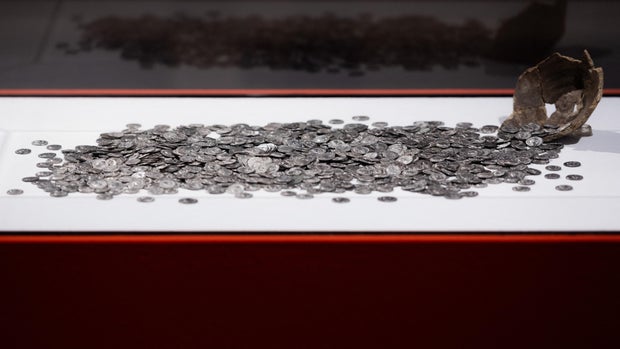
An amateur archaeologist named Oliver Riedl uncovered a significant discovery in a field in western Germany. Initially finding several Roman silver coins, his metal detector continued signaling, prompting him to contact authorities.
Upon further excavation, experts discovered a total of 934 Roman silver denarii. This hoard represents the largest collection of coins found in Germany from the era of Roman Emperor Hadrian, according to the local archaeological monuments office.
Riedl shared his experience, stating, “It was clear to me that there was something bigger buried here.” His metal detector had repeatedly indicated more coins even after he located several pieces near Wesseling, south of Cologne, a year earlier.
The collection, weighing 3.1 kilograms (6.8 pounds), is now featured at the LVR-LandesMuseum Bonn. Most of the coins originate from the Flavian emperors’ reign (A.D. 69–96), with the oldest coin dating back to 148 B.C., according to a museum announcement.
The LVR Office for the Preservation of Archaeological Monuments in the Rhineland posits that the coins were intentionally buried in the second century A.D. Erich Classen, the state archaeologist and office director, mentioned that motives for the burial can only be speculative but likely involve safeguarding the wealth. He noted the absence of banks at the time as a potential reason.
Classen explained that the treasure’s recovery remains unexplained, possibly due to the owner’s untimely death before revealing the coins’ location.
While finding treasures from Roman times is not unusual, few discoveries from the second century compare to the Wesseling hoard. The value of the coins at the time is challenging to assess, yet documented wages of Roman legionaries suggest a conceivable worth.
Rahel Otte, a research associate at the archaeological office, highlighted that a legionary earned 300 denarii annually, half of which covered food and equipment. “A legionary would therefore have had to save all of his disposable income for about six years to amass the Wesseling hoard,” explained Otte. The individual who collected this wealth remains unidentified.
The Roman presence in the Cologne region spanned approximately from 39 B.C. to A.D. 459. Under General Marcus Vipsanius Agrippa, the Romans established a military outpost that evolved into Colonia Agrippina, known today as Cologne.
Roman-era discoveries have been extensive across Europe in recent years. In February, metal detectorists in Wales located two Roman-era lead ingots, a first for the area. In central England, a Roman coin cache valued over $125,000 emerged during a construction project in 2024. That same year, Poland and a Mediterranean island revealed large finds of Roman coins.