SpaceX Falcon 9 Launches Cargo Dragon to ISS
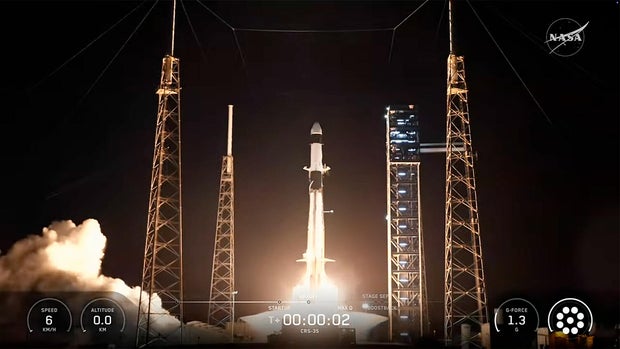
On Tuesday, a SpaceX Falcon 9 rocket launched an unpiloted Dragon cargo ship into orbit. This mission aims to rendezvous with the International Space Station (ISS) early Thursday, delivering over 6,300 pounds of research materials, spare parts, and crew supplies. Notably, the cargo includes two roll-out solar array blankets, completing a significant upgrade for the station’s solar wings.
Since June 2021, six IROSA blankets have been installed during spacewalks. The final two arrays, aboard the Cargo Dragon, will be installed during spacewalks later this month and early November.
The Falcon 9 rocket took off at 6:33 a.m. EDT from Cape Canaveral Space Force Station. It used nine first-stage engines with a thrust of 1.7 million pounds. After two-and-a-half minutes, the first stage separated and returned to Cape Canaveral. Meanwhile, the second stage continued toward orbit. During this time, observers at Kennedy Space Center witnessed the ISS passing 260 miles overhead.
The first stage landed back within feet of its launch pad at 6:41 a.m. A minute later, the second-stage engine shut down, and the Cargo Dragon proceeded independently toward the ISS.
If successful, the spacecraft will dock with the space station on Thursday at the forward Harmony module’s space-facing port at 11 a.m.
The launch also created a visual phenomenon, the “jellyfish effect,” as the Falcon 9’s exhaust plume was illuminated by sunlight. This is a notable event for rocket enthusiasts.
The Cargo Dragon carries more than 6,300 pounds of supplies, including 844 pounds for the crew, 1,307 pounds of science equipment, and 417 pounds of spacewalk gear. Fresh food, such as oranges, apples, tomatoes, and holiday items, are also part of the shipment, as addressed by Bill Spetch, space station program manager.
The IROSA solar arrays weigh 2,635 pounds on Earth and are stored in the Dragon’s unpressurized trunk. Each array generates 20 kilowatts of power. Working alongside the original arrays, they restore power levels to their original capacity.
According to Dana Weigel, director of low-Earth orbit operations, the new arrays overlay the existing ones. The old arrays still generate power alongside the new ones. The updated IROSA arrays have cells with higher efficiency and energy density, providing more power than the original arrays did when new.