Stalled Progress on Russia-Ukraine Frontline and Diplomatic Efforts
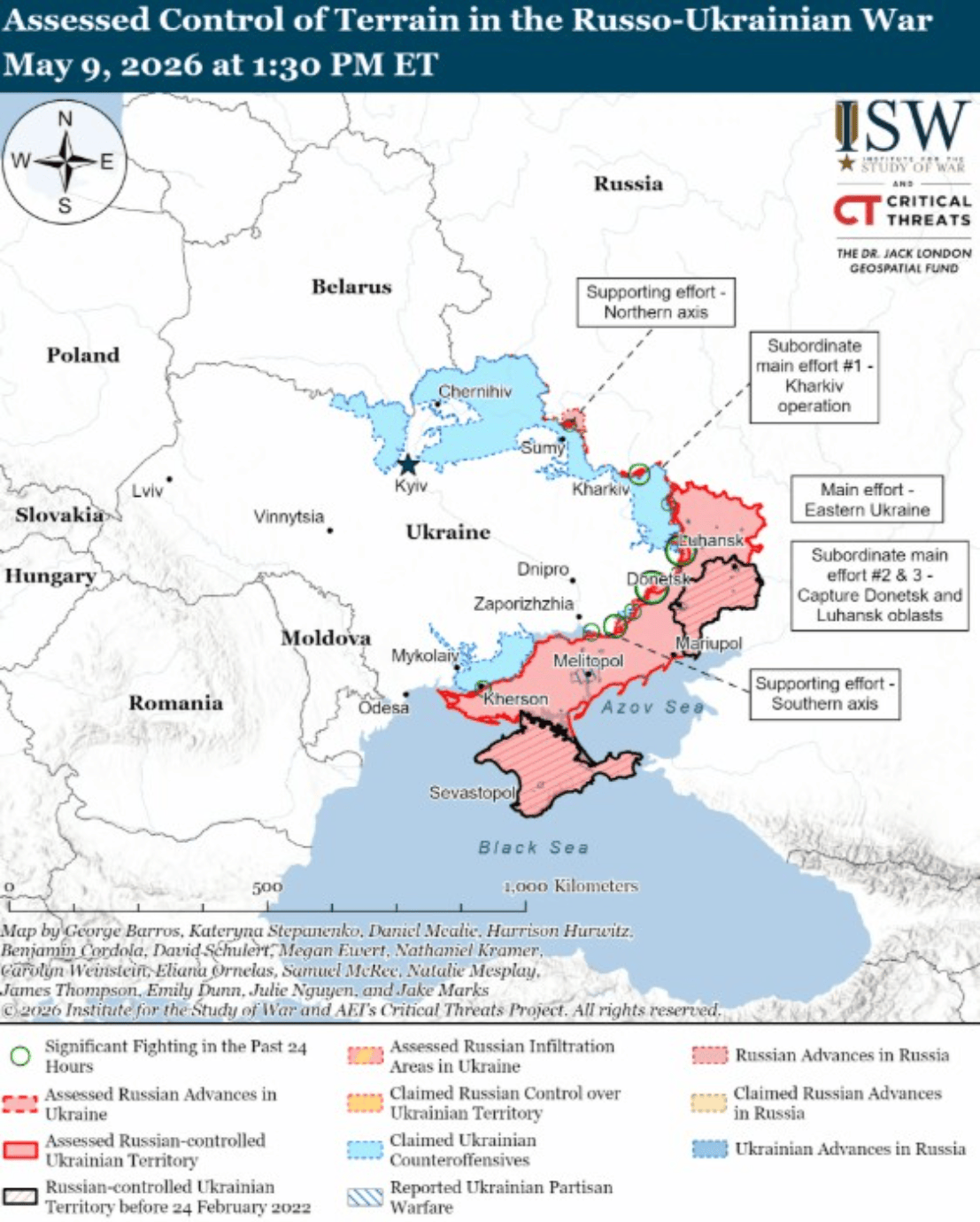
Recent maps highlight minimal changes along the Russia-Ukraine frontline from May to November. Talks in Abu Dhabi have not produced a diplomatic breakthrough. These meetings took place six months after Russian President Vladimir Putin hinted at a possible resolution to the Ukraine conflict after World War Two commemorations in Moscow’s Red Square on May 9. Putin’s suggestion involved negotiating new security arrangements for Europe.
Despite months of discussions, significant progress has not been made concerning the frontline or diplomatic negotiations. The conflict will reach its half-decade mark on February 24, 2027. Although Russian and Ukrainian negotiators agreed to a large prisoner exchange on the second day of discussions, a deadlock persists regarding Moscow’s demand for Ukraine’s withdrawal from the Donbas region, a condition Ukraine finds unacceptable. This impasse continues to hinder the resolution of political matters critical to ending the war.
Mark Temnycky, a nonresident fellow at the Atlantic Council’s Eurasia Center, noted the lack of movement, with Russia’s territorial demands remaining unmet. The Washington think tank’s maps reveal little change along the frontline since May 9. Ukraine’s launch of “Operation Vivaldi” in late May targeted the Russian stronghold north of Lyman, preventing Moscow from encircling the “Fortress Belt” of heavily defended cities.
During September and October, Russia experienced net battlefield losses due to successful Ukrainian counterattacks near Kupyansk, Oleksandrivka, and Lyman. While Moscow made territorial gains in Sumy and Zaporizhzhia, it struggled to retain ground in other sectors. Giorgi Revishvili, a military analyst and writer of Russia Analyzed Substack, highlighted Ukraine’s improved position along the frontline compared to previous years.
Revishvili pointed out Ukraine’s net territorial gains during February, May, and October of 2026, despite Russia’s ongoing personnel losses. In October, Russia suffered record troop losses of 54,000. He emphasized the unrealistic military objectives set by Putin and Russia’s military leadership, especially the goal of capturing Donbas entirely by year’s end. This reflects both determination and a misunderstanding of battlefield realities.
Ukrainian counterattacks have halted Russian advances into the Dnipropetrovsk region, neutralizing a significant Russian advance that threatened the northern flank of Slovyansk and the Fortress Belt. Revishvili explained that Ukraine’s control over operational depth contributed to Russia’s setbacks. By targeting Russian operational rear areas, such as ammunition depots and logistics hubs, Ukraine disrupted Russian operations and limited their offensive capabilities.
Outcome of Abu Dhabi Talks and Future Prospects
Rustem Umerov, head of the Ukrainian delegation,
stated that the talks concluded with an agreement on a new prisoner exchange. This represents a step toward a broader peace deal and Ukraine’s post-war reconstruction. His social media updates suggested that the first goal is to end the war and ensure security guarantees for Ukraine while acknowledging significant differences between the parties.
Temnycky expressed that the Abu Dhabi talks produced expected results, particularly the prisoner exchange agreement. This deal holds importance for Ukrainian families awaiting the return of soldiers and civilians held by Russia. He remarked on the potential for a maritime and energy ceasefire and a possible peace summit of leaders.
Upcoming meetings could prove decisive, particularly when Jared Kushner and Steve Witkoff meet with Putin in Russia, followed by discussions with Ukrainian President Volodymyr Zelensky in Ireland. Temnycky highlighted the potential for Russia’s diplomatic stance to influence the United States’ approach in continuing or escalating discussions.