State Line Bridge Removal Marks Historic Transition
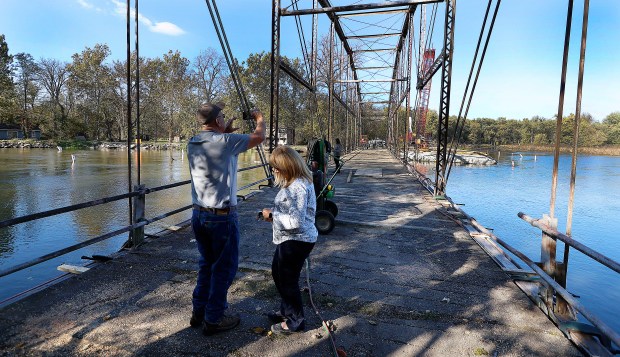
The State Line Bridge, inactive since 1999, is set to be lifted off the Kankakee River by a massive crane. This operation, weather permitting, could occur as soon as next week. The State Line Bridge project was unveiled during a ceremony on October 28, 2026, celebrated by the Kankakee River Basin and Yellow River Basin Development Commission.
Scott Pelath, executive director of the commission, acknowledged the long-standing efforts to remove the bridge. ‘The bridge has aesthetic and historical value,’ he noted, ‘yet it obstructs floodwaters, affecting communities across Indiana and Illinois.’ Pelath expressed concern about potential flooding risks that could eventually push the bridge into Illinois, turning into a salvage operation.
The plan involves a $2.5 million process to responsibly dismantle the bridge, with its components stored for potential future reconstruction. As the project progresses, Project Manager Jordan Falls and Senior Superintendent Chris Creasbaum provided details on the removal technique. A giant crane will lift and transport the 224-foot-long, 165,000-pound bridge away from its current site, which rests 88 feet into the marshland.
This isn’t the first time the bridge has relocated. Originally built around 1900 near Sun River Terrace, Illinois, it moved to its current position in 1920. Currently, it spans the river between Lake and Newton counties, noted for its Pennsylvania truss design according to the National Park Service.
The State Line Bridge frequently floods, compounded by its low two-foot elevation above the river. It collects debris during floods, complicating safe water passage. Modifications to the Kankakee River in Indiana a century ago, including draining the Grand Kankakee Marsh, created a significant transformation in the river’s flow.
Local residents, such as Toby Timmons and State Rep. Jim Pressel, shared personal histories associated with the bridge and river. While Timmons reflects on changes to local fishing access, Pressel recalls impactful floods leading to the commission’s formation. The commission has successfully managed flood risks through strategic improvements, including levee enhancements and debris removal.
Commission members, including John McNamara and Mike Aylesworth, recounted historical and practical challenges associated with the river and the bridge. McNamara noted the satisfaction of completing this project after 50 years of dedication.
At the heart of the story, individuals like Dolores Aylesworth provide personal anecdotes about life along the Kankakee, painting a picture of an area shaped by its waterways. The removal of the bridge represents both a conclusion and a new beginning for the community, ensuring safety and preserving heritage while adapting to contemporary needs.