Sweden’s Election: A Shift in Political Dynamics
Sweden will hold a pivotal election on Sunday that may alter the political landscape for the Nordic nation and its role in NATO. Recent years have seen significant gains for right-wing populist parties across Europe, fueled by voter dissatisfaction over immigration. Sweden is experiencing similar trends.
The election presents a contest between Prime Minister Ulf Kristersson’s center-right coalition and a center-left alliance led by former Prime Minister Magdalena Andersson of the Social Democrats. However, a key aspect of the race is the potential for the right-wing populist Sweden Democrats to gain government positions, marking a significant change.
The Sweden Democrats, once linked to Sweden’s extreme-right fringe, have progressively become a central political force. The party first gained parliamentary presence in 2010 and by 2022, it became the second largest political entity, supporting Kristersson’s minority government externally. Though not formally in government departments, they have wielded considerable influence over immigration and crime policies. Kristersson now aims to form a majority government, promising ministerial roles for Sweden Democrats if his coalition wins.
This election challenges the normalization of the Sweden Democrats and their acceptance by Swedish voters. Andreas Önnerfors, a professor at Linnaeus University, highlighted that the focus has shifted from political issues to government composition.
An Indikator Opinion poll conducted in early September places the center-left coalition slightly ahead with 50.8% against the right coalition’s 47.6%, indicating a closely contested race.
From Fringe to Mainstream
Sweden’s established parties have historically distanced themselves from the Sweden Democrats due to their extremist origins. In 2018, Kristersson assured Holocaust survivor Hédi Fried of non-cooperation with the party. Sweden Democrats recognize connections in their early history to neo-Nazi and white supremacist movements.
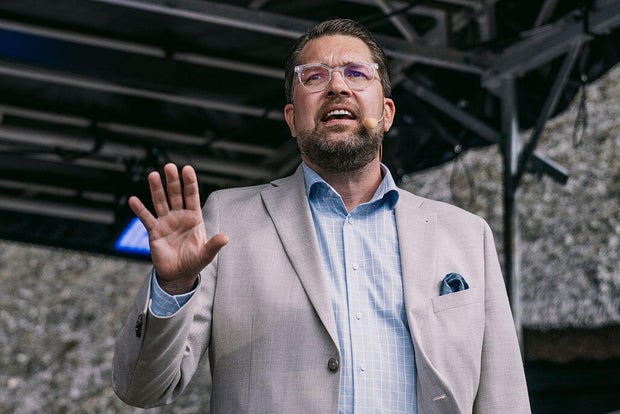
Under leader Jimmie Åkesson, who took over in 2005, the party has expelled radical elements, adopted a moderate stance, and presented as mainstream right-wing with policies like deporting illegal residents, tightening citizenship requirements, ensuring immigrant assimilation, and limiting social security to citizens.
The party’s success is partly due to blending traditional right-wing stances with working-class voter-focused policies, creating an appealing platform for ordinary citizens, as Önnerfors noted.
Key Voter Concerns: Immigration and Crime
Tougher stances on immigration and crime are integral to Sweden Democrats’ politics. Their enduring popularity also reflects shifts within Swedish society.
Politically, Sweden has moved toward more restrictive approaches regarding immigration and crime. Niklas Bolin, a political scientist at Mid Sweden University, stated that both right and left parties, including Social Democrats, Sweden’s largest party, have moved in this direction.
During the 2015 European migration crisis, Sweden received approximately 163,000 asylum applications, one of the highest per capita rates in Europe, with a population under 11 million. Integration challenges, segregation, and increased gang violence became pressing issues. Asylum immigration has dropped to its lowest since 1985, according to the Swedish government.
Government measures appear to have reduced gang violence. Police data shows shootings declining from 391 in 2022 to 158 in 2025, with further reductions this year.
The political impact of immigration, integration, and violent crime continues. Sweden Democrats maintain a firm electoral base linked to dissatisfaction with established parties, especially among men, working-class voters, and those outside major urban areas.
Sweden, known for low crime rates, a robust welfare system, and liberal immigration policies, faces a crucial test in this election to determine the extent of its political shift and the potential rise of a previously marginalized party into central governance.