The Impact of School Closures on Marginalized Communities
Schools across the nation are grappling with declining student numbers, reduced budgets, expired pandemic relief, and the prospect of closures. Education leaders must reduce costs while accelerating academic recovery. Unfortunately, closures do not affect all communities equally. Research indicates that Black and low-income students are disproportionately affected. These groups already face significant challenges post-pandemic.
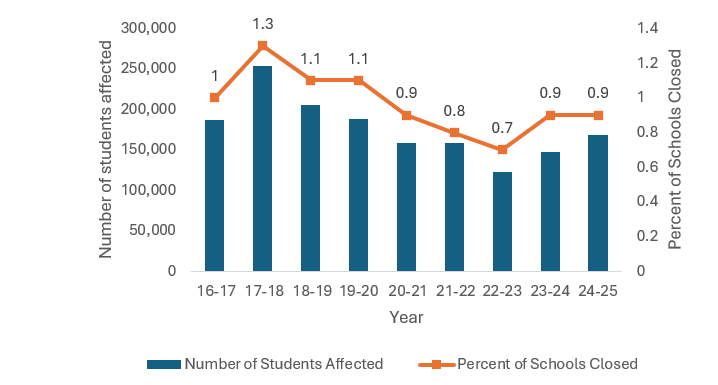
In the last decade, approximately 1% of schools have closed annually, affecting 100,000 to 250,000 students each year. This rate equates to the elimination of a large school district yearly. During the COVID-19 pandemic, closures slowed because of paused accountability policies and federal funding. However, with those supports waning, closure rates are rising back to pre-pandemic levels.
The Unequal Impact of School Closures
Black and low-income communities bear the brunt of school closures. Majority-Black and high-poverty schools are often the focus due to systemic inequities. In 2024-2025, schools serving mainly Black students made up a quarter of closures, despite being less than 10% of schools. High-poverty schools also show similar disproportionality.
This issue is not due only to enrollment drops. Schools serving Black students, even with equal enrollment declines, face higher closure risks. In some cases, for high-poverty schools with a 50% drop, those serving all Black students had double the closure rate of others.
Disruptions from Closures
School closures disrupt student relationships and learning environments. Students reassigned to similar or lower-quality schools often face short-term academic setbacks. In Chicago, displaced students experienced reading and math setbacks without gains unless they moved to better schools. In Philadelphia, no achievement gains materialized unless students transferred to much-improved schools. Additionally, displaced students often faced further travel, increasing absences and suspensions.
Financial and Social Costs
School closures may not always result in cost savings. Research shows varied fiscal benefits from closures, with Texas as a case study highlighting declines in test scores, rises in disciplinary issues, lower graduation rates, and diminished college and employment outcomes. The impact is more severe for economically disadvantaged students from low-performing schools.
Equitable Solutions
To protect learning and advance equity, districts should “right-size” without dismantling community-anchoring schools in Black and low-income areas. When closures are unavoidable, district strategies must be equitable and transparent, involving community engagement. Students should be assured placement in schools that are at least equal in quality. Additionally, receiving schools should manage increased enrollment with reduced class sizes, transportation support, and enhanced counseling.
Addressing the root causes of closures is essential. Issues like gentrification, reduced state funding, and broader economic patterns contribute to declining enrollment. District leaders require support in addressing these structural problems.
School closures alter children’s lives. Some closures may be necessary, but the burden should not repeatedly fall on the same communities. Leaders must choose policies that protect students’ progress and shield the most vulnerable children from further sacrifice.
Megan Kuhfeld, Ph.D., serves as director of growth modeling and data analytics at the Northwest Evaluation Association, where Ayesha K. Hashim, Ph.D., works as a lead research scientist.