Tropical Storm Rachel and Its Potential Impact on Southern California
Tropical Storm Rachel is approaching the West Coast with a predicted landfall in either northern Baja California or San Diego County as early as Saturday night. The National Hurricane Center has highlighted potential hazards, including damaging coastal flooding.
Weather Patterns and Water Temperatures
Rachel is currently hundreds of miles off the coast of San Diego. Unlike the typical behavior of such storms in the tropical eastern Pacific, Rachel may gain strength before making landfall. Storms usually weaken in the cooler waters of this region, but current conditions are different. El Niño and a marine heat wave are increasing ocean temperatures by 10 to 13 degrees above normal.
“It’s notable that this unusual event is being made possible by both the early arriving low-pressure trough off the coast of California and the record warm ocean temperatures,” said Daniel Swain, a climate scientist at UC Agriculture and Natural Resources.
Flooding Predictions and Warnings
The National Weather Service office in San Diego has issued a rare tropical storm watch for most of San Diego County, including San Diego, Chula Vista, Carlsbad, and Oceanside. Tropical storm-force winds could pose a threat within the next 48 hours. This is only the second time such a watch has been issued in California.
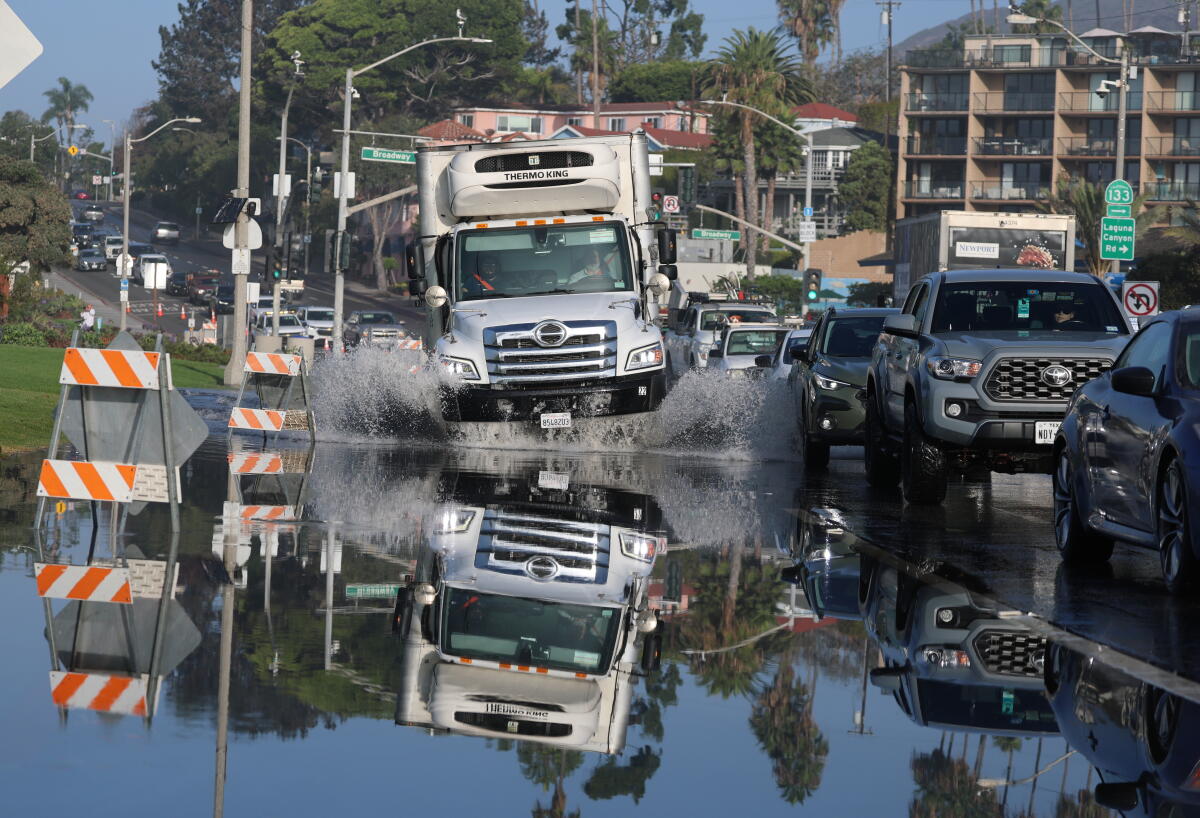
Coastal flooding is the primary concern. South-facing shores are at risk due to high tides, elevated water levels, and the incoming storm. The region may experience water intrusion, hazardous surf from 3 to 6 feet, and rip currents. Streets in Laguna Beach were already flooded on Friday morning.
Tides in Southern California are predicted to be 1 to 1.5 feet higher than usual due to the warm ocean temperatures from El Niño. At 9 a.m. Friday, tides in San Diego and La Jolla were 17 inches higher than the official prediction. Santa Monica and San Francisco experienced similar increases.
Meteorologist Miguel Miller from the National Weather Service stated, “We’ve got water that’s already high and then we’re going to have periods of high tides each morning and evening and then on top of that we have high surf.”
A coastal flood advisory remains in effect for Ventura, Los Angeles, Orange, and San Diego counties through Tuesday afternoon. This warning includes potential flooding in beach parking lots, boardwalks, and roads, with isolated road closures and minor erosion.
Rainfall Expectations
The remnants of Rachel are expected to bring light rain to much of Southern California from Sunday morning to Monday night. More significant rainfall is anticipated in the Mojave Desert, Inland Empire, and parts of San Diego County. The weather service predicts a 40% chance of excessive rainfall leading to flash flooding in areas like San Diego and Palm Springs.
A moderate risk of flash floods exists, with many streams potentially flooding, including the San Diego River near Fashion Valley. There is a 15% chance of this in areas like Oceanside and Riverside, and a 5% chance in places like Huntington Beach and Barstow. Los Angeles County expects light to moderate rain, with heavier precipitation in the San Gabriel Mountains.
Orange County could see up to an inch of rain in coastal areas. Coastal sections of San Diego County might receive an inch to an inch and a half of precipitation, with higher amounts inland.
Historical Context
Southern California rarely experiences tropical storms. Only two have made their presence felt in the modern record. The first was in September 1939, known as El Cordonazo, which had significant impact on Long Beach and San Pedro. In September 1997, Nora briefly reached tropical storm strength but did not cause as much damage in California as in Baja California.
Both instances were linked to El Niño seasons. These periods often see increased hurricane activity in the eastern Pacific and heightened rainfall in Southern California during winter.
The Climate Prediction Center recently stated that this season’s El Niño is expected to be categorized as “very strong.” Historically, “very strong” El Niños occurred in 1982-83, 1991-92, 1997-98, and 2015-16. Some of these brought exceptional rainfall, while others, like the one in 2015-16, coincided with significant coastal erosion.