Alan Greenspan: A Legacy of Economic Influence and Controversy
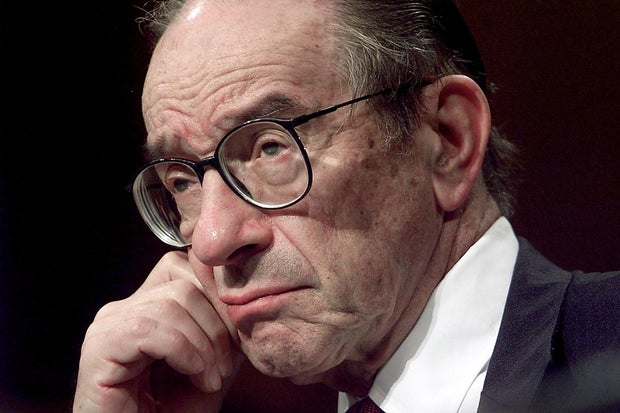
Alan Greenspan, an influential economist and former chairman of the Federal Reserve, passed away on Monday at the age of 100. His wife, Andrea Mitchell, confirmed his death due to complications from Parkinson’s Disease. Greenspan served under four U.S. presidents and was one of the longest-serving Fed chairs in U.S. history.
Greenspan’s tenure at the central bank is often associated with the Great Moderation, a period from the mid-1980s to 2007 characterized by economic stability, low inflation, stock market gains, and robust growth. However, his time in office also involved navigating several financial crises such as the 1987 stock market crash and the early 2000s dot-com bubble burst. In 1996, he famously used the term “irrational exuberance” to describe speculative bubbles driven by investor overconfidence.
Controversy surrounds Greenspan’s association with the 2008 global financial crisis and the Great Recession that followed. Although he left the Fed in 2006 before the crisis struck, critics argue his policies contributed to the subprime housing crisis. According to The Economist, Greenspan was criticized for his belief in market efficiency and for not taking stronger regulatory measures in the late 1990s and mid-2000s.
Greenspan defended his actions, as reported in a 2007 Fortune Magazine interview, stating he had cautioned about risks in the housing market. He admitted he initially underestimated human behavior’s role in economics but later recognized it as crucial, acknowledging people’s tendencies towards euphoria and fear.
Known for his cryptic economic commentary, Greenspan pushed for more transparency in Federal Reserve communications. Commenting on Fed policy, he stated in 2009 that surprising markets without purpose was counterproductive.
Born in New York City on March 6, 1926, Greenspan displayed mathematical talent from a young age. Despite his early musical interests, which included studying at Juilliard, he pursued economics at New York University, where he earned his bachelor’s, master’s, and doctoral degrees. He also became an admirer of Ayn Rand’s philosophy and participated in her intellectual gatherings.
Greenspan’s career began with the National Industrial Conference Board, analyzing industrial demand, before founding his consulting firm Townsend-Greenspan & Co. He held positions such as chairman of the President’s Council of Economic Advisers under Gerald Ford and was part of Ronald Reagan’s Economic Policy Advisory Board. Appointed as Fed chair in 1987 by Reagan, he was reappointed by three subsequent presidents: George H.W. Bush, Bill Clinton, and George W. Bush.
Greenspan retired in 2006 and married journalist Andrea Mitchell in 1997. Reflecting on his career, he noted to Fortune Magazine that while some presidents hinted at interest rate cuts, none explicitly requested them.