Tensions Rise as Trump Criticizes Canada Over Wildfire Smoke
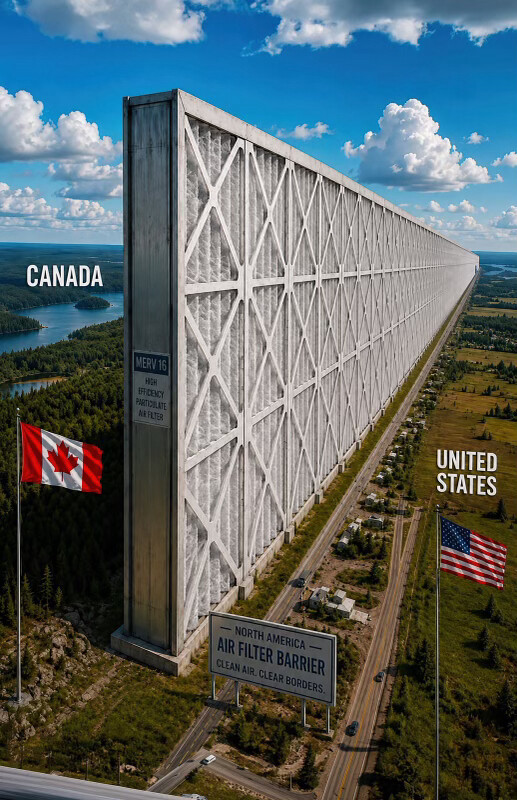
President Donald Trump recently posted an image on Truth Social, depicting a large artificial air filter along the U.S.-Canada border. The image suggests a filtration system designed to address the wildfire smoke drifting into the United States from Canada. This post marks another escalation in Trump’s criticism of Canada as cross-border tensions grow.
History of Cross-Border Cooperation
Canada and the U.S. have a long-standing history of cooperation during wildfire emergencies. Resources and personnel are often shared between the two nations, especially during intense fire seasons. Despite this, Trump’s recent comments suggested imposing tariffs on Canadian goods to offset the economic impact of the smoke on U.S. air quality.
The Post’s Imagery
The image shared by Trump features a massive border filtration barrier labeled as a “MERV 16 High Efficiency Particulate Air Filter.” The Canadian and American flags appear on the left and right sides, respectively. The barrier includes a sign reading, “North America Air Filter Barrier. Clean Air. Clean Borders.” This is part of Trump’s broader critique of Canada’s forest management strategies.
Canada’s Response
Canadian Prime Minister Mark Carney responded to Trump’s remarks by emphasizing Canada’s efforts to combat wildfires. Carney highlighted the vast area of Canada’s forests—much larger than Texas—and the drought conditions stretching from Texas to Minnesota. Carney expressed his commitment to managing the wildfires effectively, as reported by CBC News.
Understanding Canadian Wildfires
Wildfires in Canada are common within its expansive boreal forests. Recent fires have become more severe due to rising temperatures and drier conditions. Experts say these factors contribute to longer fire seasons and more intense fires. Natural causes, such as lightning, often ignite these fires, while human activities can also be a factor.
Many current fires are located in remote northern regions like Ontario, complicating efforts to suppress them. The challenging access limits firefighting capabilities in these areas.
Impact on U.S. Air Quality
Smoke from Canada’s wildfires affected the Great Lakes and Northeast U.S. last week. Cities like Chicago, New York City, and Detroit experienced reduced visibility and poor air quality. Residents reported orange skies and a strong smell of wood. Though some smoke has dissipated, meteorologists forecast more smoke across the U.S. in the coming days.
Looking Ahead
Canada’s wildfire season usually peaks from May to September. As temperatures cool and rain falls, fire activity eases, reducing smoke and air quality concerns. However, if dry conditions persist, further issues may arise for northern U.S. regions.