Educating the Next Generation About 9/11: Policies Across the U.S.
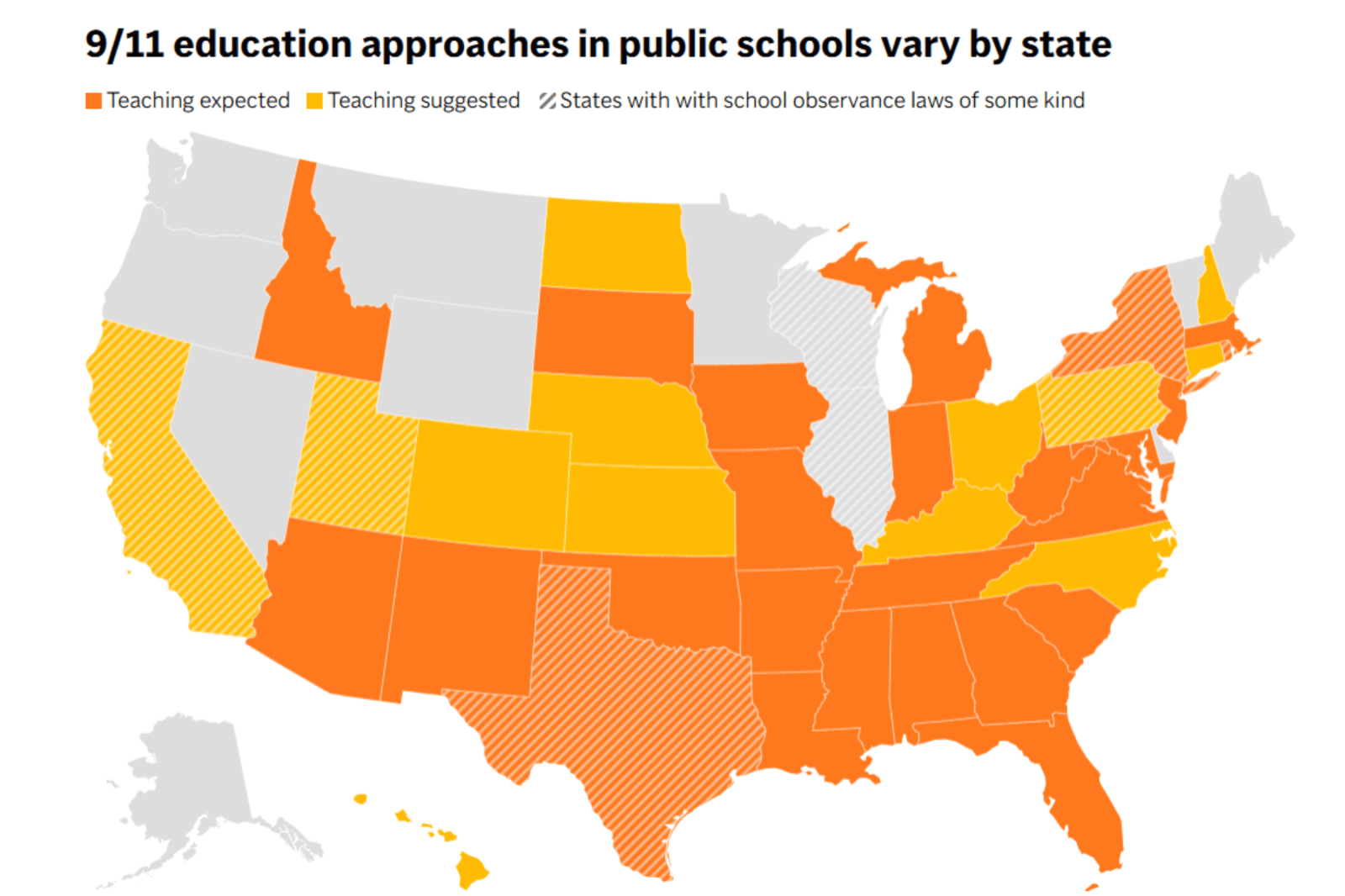
As the United States approaches the 25th anniversary of the September 11 attacks, schools across the nation are implementing policies to educate students about this pivotal event in modern American history. Research conducted by The Associated Press (AP) reveals that 40 states either require or suggest that public schools address the topic of 9/11. Among these, 25 states have specific laws or standards mandating instruction on the attacks, while 13 states offer optional guidance regarding the subject. Furthermore, several states advocate for moments of silence or other commemorative observances, enhancing the total number of states with a 9/11-related policy to at least 40.
With approximately one-third of Americans having been born after the terrorist attacks by al-Qaida, where four planes were hijacked resulting in nearly 3,000 casualties across New York City, the Pentagon, and Shanksville, Pennsylvania, many of today’s students are quite distant from the events of that day. Education professor Jeremy Stoddard from the University of Wisconsin, who focuses on 9/11 instruction in schools, informed Newsweek that the attacks are increasingly perceived as a historical event rather than a personal experience. Teachers are now emphasizing the ongoing impact of post-9/11 policies on students.
States’ approaches to teaching 9/11 vary significantly. Some mandate direct classroom instruction regarding the attacks and their aftermath, while others integrate the topic within broader themes such as U.S. history, civics, terrorism, and foreign policy. There are also states that simply encourage commemorative observances.
Alabama, for instance, requires students to study post-9/11 U.S. military actions and evaluate America’s response, including the establishment of Homeland Security and the Patriot Act. Arizona once enforced statewide requirements for age-appropriate education related to 9/11, which were later altered to apply only to students in grades seven through twelve.
According to education experts, teaching 9/11 becomes increasingly critical as fewer students have a personal link to the attacks. Stoddard stated that this generational gap poses challenges because many students and even teachers lack direct memory of the event. He emphasized the importance of sharing stories and enhancing understanding. Gordon Felt, whose brother perished on United Airlines Flight 93, expressed concern that omitting the narrative altogether is the greatest threat.
During seminars at the Flight 93 National Memorial, educators explored the challenges of teaching a generation unfamiliar with the attacks, including considerations for younger students, remembering victims, and gleaning broader historical insights. Stoddard noted shifts in classroom approaches over time, with educators initially focusing on the anniversary and heroism, but now adopting wider historical perspectives, analyzing the enduring impacts of 9/11 responses like the Patriot Act.
The willingness of states to integrate 9/11 into curriculum standards has increased over time. Initially, around 60 percent of states omitted the attacks from their educational standards, but recent expansions have increased the depth of curricular requirements. A teacher survey near the 20th anniversary highlighted this shift, indicating a more expansive understanding of 9/11 and its consequences on American life.
The Diverse Approaches to Teaching 9/11
The national landscape surrounding 9/11 education is not a simple division between states that teach the event and those that do not. There are three primary categories of requirement:
- Dedicated instruction: States like Arizona and Florida have explicit mandates for instruction about the attacks.
- Curriculum standards: States including Alabama, Arkansas, and others have integrated 9/11 into expected social studies content.
- Commemoration: States like California and New York focus on observances, though requirements vary.
A secondary group of states, such as Alaska and Colorado, offers teachers suggested content without specific mandates, while others, like Minnesota and Washington, lack formal statewide policies on teaching 9/11. This reflects varied methodologies in state reviews by different researchers. Stoddard co-authored a 2026 University of Wisconsin analysis showing fewer states had explicit requirements when focusing on official standards and legislation.