New World Screwworm Fly Detected in South Texas, Prompting Agricultural Vigilance
The U.S. Department of Agriculture confirmed the presence of the New World screwworm fly in south Texas, marking the first time in decades this flesh-eating larvae has threatened the national cattle industry. This is only the third appearance of this parasite in the U.S. during that timeframe.
Agriculture Secretary Brooke Rollins reported that a 3-week-old calf in La Pryor, Texas, about 50 miles from the Mexico border, was the identified case. Texas State Veterinarian Bud Dinges has established a 12-mile quarantine zone, prohibiting movement of any warm-blooded animal outside that area without inspection. Rollins reassured that no other detections have been found in the U.S. and noted that infested livestock can recover with proper treatment.
For over a year, U.S. and Texas agriculture officials have warned of the pest’s movement across Mexico, recalling its potential for causing significant economic loss before its eradication in the 1970s. This is the first confirmed case in Texas since 1966.
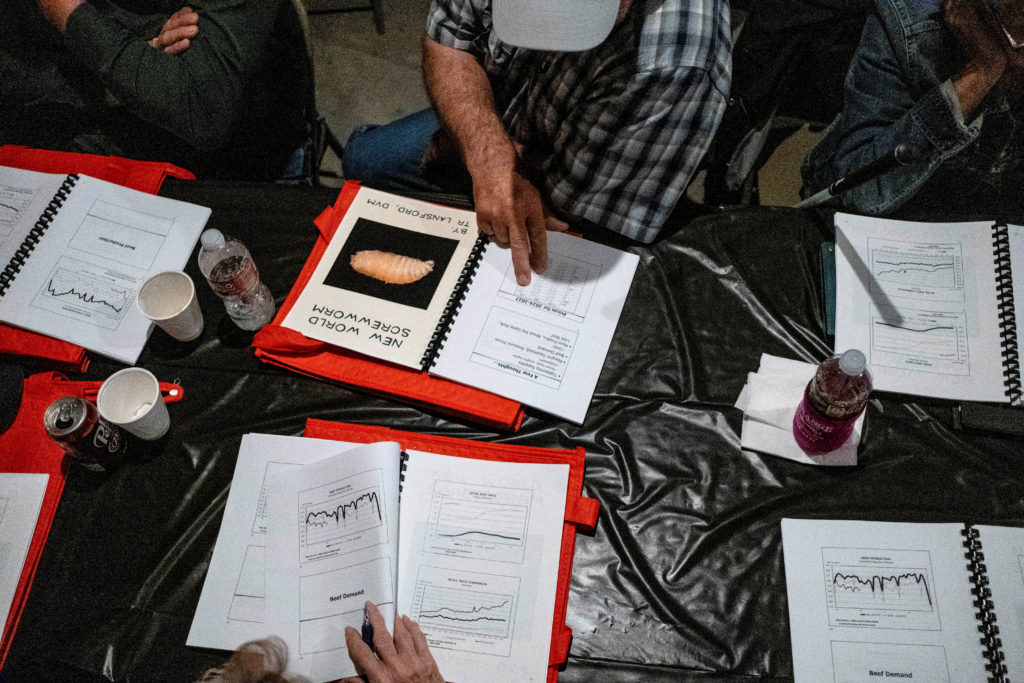
Paul Janda, a cattle rancher from Schulenburg, Texas, analyzed documents covering the economics and the screwworm parasite threat during the Fayette County Cow/Calf Clinic and Trade Show in La Grange, Texas, on May 1, 2026. Photo by Joel Angel Juarez/Reuters.
To combat the fly, millions of sterile screwworms have been released to mate with wild females. This method successfully eradicated the pest before. The USDA believes there is no risk of a mass infestation forming.
Rollins made this announcement shortly after an online news conference, noting cases confirmed in Mexico near the U.S. border, and detailed ongoing USDA efforts to prevent the fly’s establishment in the U.S.
The New World Screwworm fly, a tropical species, lays eggs in open wounds, and the larvae consume flesh. Though infestations can lead to death if untreated, the parasite doesn’t affect food. Previous outbreaks were effectively contained, like the Florida Keys case in 2016.
Cattle in Rio Grande City, Texas, on July 16, 2025. File photo by Gabriel V. Cardenas/Reuters.
Federal health officials confirmed one case in a Maryland resident in 2025, who recovered with no further transmission. The female flies mate once in their lifespan, and sterile fly programs aim to gradually eliminate the species by preventing egg hatching.
The USDA has reinitiated facilities for breeding sterile flies. A $21 million investment is being made to adapt a southern Mexico fruit fly facility for screwworm flies. A dispersal center has opened in southern Texas, with further infrastructure developments underway.
Visionary efforts include 8,000 fly traps along the U.S.-Mexico border and over 58,000 fly samples tested. Last year saw the closure of the U.S.-Mexico border to livestock imports, a measure Rollins stood by during her news conference.
Despite the fly’s capability to travel with people or wildlife, its autonomous travel range is limited. The quarantine zone is crucial and Dinges urged ranchers and pet owners to adhere to restrictions to prevent further movement of this pest.
A free press maintains the health of democracy. Support trusted journalism and civil dialogue.