Dialogue Programs on College Campuses Foster Understanding
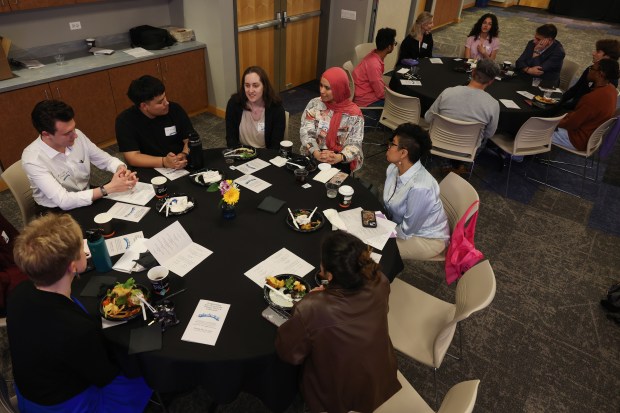
Isabela Torres Reyes has made progress in her communication skills over the past six months. Initially eager to voice her thoughts, she now embraces a more thoughtful approach, thanks to a 10-week dialogue course. This course is part of DePaul University’s Bridgebuilding Fellowship, designed to enhance dialogue skills among students with different ideologies. Torres Reyes has learned the importance of considering someone’s background and experiences to understand their perspectives. She now asks questions like, “What do you care about that I’m not seeing?”
The program highlights the challenge of having uninterrupted conversations. Often, people want to speak their minds, leaving little room for open dialogue. Torres Reyes sees this skill development as crucial, especially within the college environment. Dialogue programs are becoming common on campuses as they combat a prevalent issue in higher education: lack of conversation opportunities. Polarization in campuses is concerning, with a Pew Research Center survey indicating that nearly half of colleges offer limited exposure to diverse viewpoints.
The recognition dinner for the Bridgebuilding Fellowship at DePaul University’s Lincoln Park Student Center showcased the efforts to enhance dialogue skills. Speakers like Tyler Shasteen from the University of Chicago emphasized the importance of engaging with differing beliefs through the school’s civic policy institute. He found value in building relationships with those holding diverse perspectives.
Dialogue programs at DePaul and U. of C. are part of a larger initiative to combat polarization. They aim to bring students together for productive interactions. At DePaul, the Bridgebuilding Fellowship, launched in 2025, guides students in developing communication skills through courses and events. Participants learned about tone, delivery, and listening with intent, realizing the value of seeing beyond mere opinions.
At the University of Chicago’s Institute of Politics, students like Ava Partridge benefited from face-to-face interactions, which added depth to relationships. She noted that meeting people in person humanizes them, fostering understanding despite political differences. Her experiences over four years revealed that relationships between differing ideologies are feasible.
Programs at other Chicago institutions such as Loyola University and Northwestern University also aim to bridge divisions. Loyola’s Community Circles program focuses on conflict resolution, while Northwestern’s Litowitz Center for Enlightened Disagreement offers seminars and residential programs for first-year students. These initiatives help participants improve listening skills, understand personal biases, and engage in constructive dialogue.
DePaul President Robert Manuel believes that higher education institutions should prioritize productive dialogue. In his view, the essence of higher education lies in encouraging meaningful connections among students. He asserts that although this approach should be the norm, institutions must lay the groundwork internally to foster a community connected by dialogue and understanding.