AfD’s Rise in Saxony-Anhalt: Key Figures and Policies
Recent Elections in Saxony-Anhalt
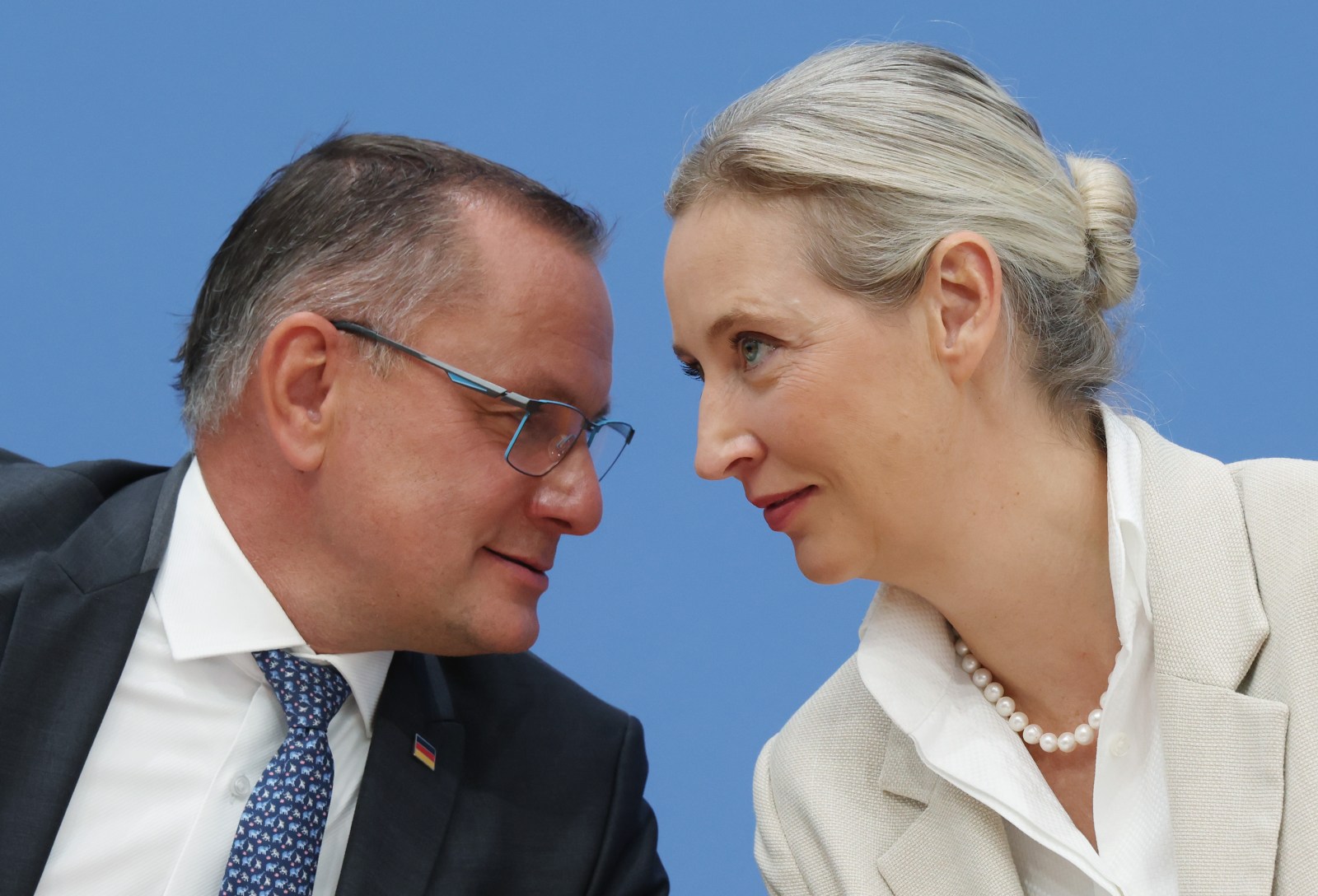
Alice Weidel and Tino Chrupalla, leaders of the Alternative for Germany (AfD), celebrated a significant election win in Saxony-Anhalt. The election results revealed that the AfD secured 44% of the vote. This positioned them well ahead of the Christian Democratic Union (CDU), which gained 17.2%. Despite this success, the AfD did not achieve an outright majority. This marks a pivotal moment as no far-right party has governed a German state since World War II.
The future path for the AfD in Saxony-Anhalt remains uncertain. The party’s anti-immigration policies, promoted by Weidel and Chrupalla, are expected to play a central role in upcoming coalition talks.
“They are smart enough to not be too easily put into any one corner of a political orientation,” said Markus Böckenförde, an associate professor at the Central European University.
Alice Weidel: Background and Influence
Alice Weidel, 47, was born in Gütersloh and has co-chaired the AfD since June 2022. With a doctorate in economics, she previously worked at the Bank of China and lived in China for six years. Her admiration for Margaret Thatcher is well-known, appreciating her policies on low taxes and privatization.
Weidel joined the AfD in 2013, attracted by its Euroskeptic views. She quickly advanced to the federal executive committee by June 2015. By April 2017, she became the co-lead candidate of the party. In 2018, Weidel faced reprimand for controversial remarks about refugees in the German parliament.
Despite the AfD’s strong stance on traditional family values, Weidel is in a civil partnership with Sarah Bossard. The couple lives in Switzerland with their two adopted sons. Weidel spends her time between Berlin and Switzerland but lists her official residence in Überlingen.
Tino Chrupalla: Co-Leadership and Vision
Tino Chrupalla, 51, has been co-chair with Weidel since 2019. Born in Weißwasser, Chrupalla’s career began as a house painter and later a business owner. He joined the AfD in 2015 and was elected to its district committee in Görlitz the following year.
Chrupalla’s influence in the Bundestag includes serving as one of five deputy chief whips. Known for moderate views, he emphasizes border security as a priority. In a July conference, Chrupalla expressed the party’s growth into a “people’s party” with aspirations to govern at both state and federal levels.
Overview of AfD Policies
Founded in 2013, the AfD originated as a right-wing and Euroskeptic alternative to the CDU. Its policies have since drifted further right, including opposition to immigration, Islam, and the EU.
The AfD calls for lifting sanctions on Russia and maintains its domestic focus on strict immigration control and potential deportation measures. The party resonates strongly in former East Germany with its emphasis on migration and crime.
In Saxony-Anhalt, the AfD is identified as “right-wing extremist” by domestic intelligence, a label its lead candidate Ulrich Siegmund disputes. Markus Böckenförde noted that with an absolute majority, the AfD might attempt to alter educational agendas and state-controlled areas such as policing.