Alaska’s Voting System and Key Senate Race
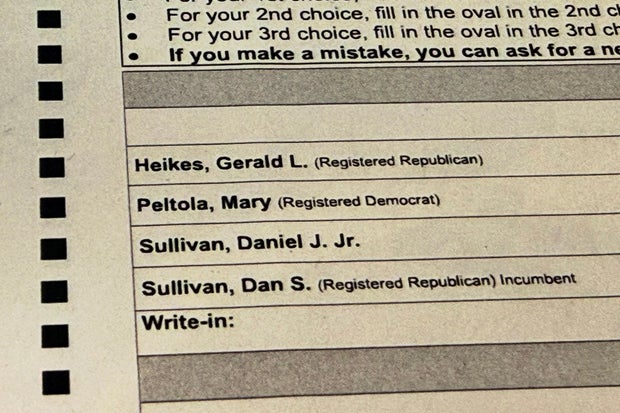
By November 2, 2026, voters in Alaska are casting their ballots in significant races, such as a Senate election drawing considerable attention. This is due to a candidate with a name similar to the incumbent senator, Dan Sullivan. Alaska’s election system is also under scrutiny. The state recently adopted a top-four nonpartisan primary and ranked choice voting for general elections.
Understanding Ranked Choice Voting
Ranked choice voting allows voters to rank candidates by preference rather than selecting a single option. Introduced in 2022, this system aims to reduce political polarization by moving away from party primaries. The top four candidates in a nonpartisan primary advance to the general election.
On election day, if a candidate receives more than 50% of the top-choice votes, they win. If not, the process moves to a second round. The candidate with the fewest votes is removed, and their votes are redistributed to their voters’ next choice. This continues until one candidate achieves a majority.
For example, consider 100 voters in an Alaska Senate race. If Candidate A garners 50 top-choice votes, Candidate B gets 40, Candidate C seven, and Candidate D three, no candidate surpasses 50%. Candidate D is eliminated, and their votes go to the voters’ second choices. If Candidate A then receives 51 votes, they win.
In 2022, a special House election under this system resulted in Democrat Mary Peltola winning a majority 15 days after the initial vote. Peltola later secured a full term, winning in the second round with 55% after first receiving 48.8%.
Alaska Senate Candidates
The Alaska Senate race could influence the balance of power in the upper chamber. The ballot includes four options: GOP incumbent Sen. Dan S. Sullivan, similarly named Daniel J. Sullivan, Republican Gerald Heikes, and Peltola.
Sen. Sullivan, a Marine veteran and former State Department official, faces Peltola, the first Democrat to represent Alaska in the House in 50 years. Daniel J. Sullivan, a former teacher, entered the race without success in getting barred from the ballot.
Senate Race Candidacy Controversy
Daniel J. Sullivan’s candidacy led to legal battles over his presence on the primary ballot. The state supreme court allowed his inclusion and instructed the Division of Elections to manage his listing. In a recent open Senate primary, Peltola led with 49.5%, followed by Sen. Sullivan at 41.4%, while Daniel J. Sullivan received 2.5%.
The ballot identifies the senator as “Sullivan, Dan S. (Registered Republican) Incumbent,” while Daniel J. Sullivan lacks additional identifiers. The latter candidacy has raised voter confusion concerns, prompting the Justice Department’s attempt to intervene.
The Trump administration filed a lawsuit to prevent election certification if Senator Sullivan loses to Peltola. A federal judge dismissed this, citing lack of legal standing for the suit. The Justice Department plans an appeal.
The New York Times reported political operatives associated with Peltola’s campaign secretly recruited Daniel J. Sullivan to divert votes from the senator. Peltola denies involvement.
Vote Counting Duration in Alaska
Experts caution that Alaska’s election process will take time. The state’s vast geography and mail ballot counting contribute to this. Mail ballots are counted up to 10 days post-Election Day, or 15 in specific cases. Ranked choice voting tabulation starts 15 days after the last ballot count. If no candidate secures more than 50% initially, the process could extend for weeks.
Officials aim to certify results by November 25. In 2022, Peltola’s full-term victory was confirmed by November 30.