Challenges Amid Changes at Central Avenue Farmers Market
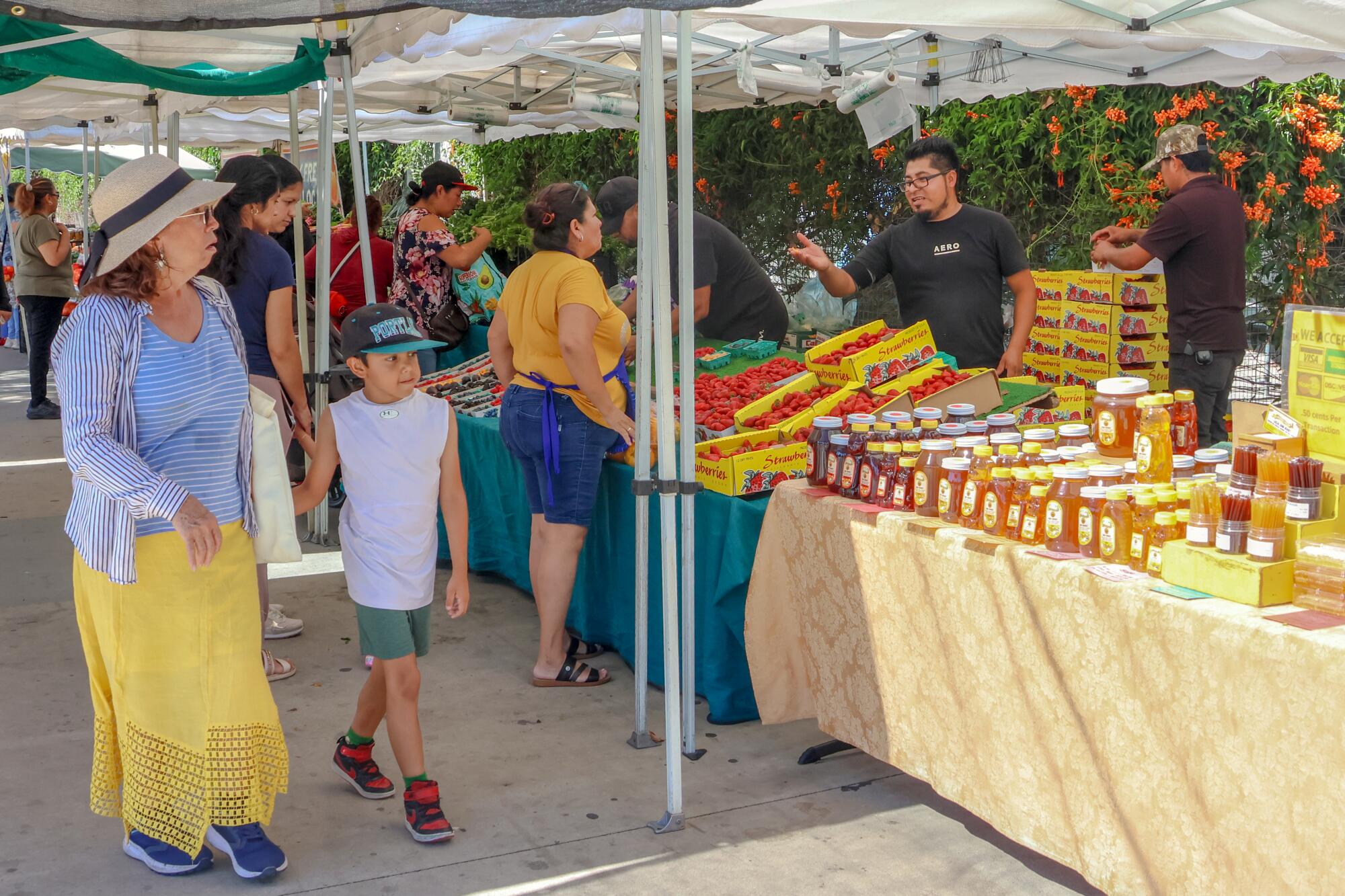
On a scorching Thursday morning at the Central Avenue Farmers Market, kids play around vendor booths while others rest in strollers. A lively atmosphere prevails as Spanish and English fill the air. Today marks an important moment for the neighborhood.
After ICE raids unsettled the South L.A. community about a year ago, market organizers moved the weekly farmers market to a private and cramped courtyard away from the street. Alejandro Corona, the market manager, recalls last June’s incident that led to the relocation. “A woman stepping off the bus was taken,” he said. “Our customers didn’t feel safe.”
The market is now visible again, with bilingual signs advertising EBT, agricultural programs, and social services. “Today we’re celebrating,” Corona says. He and other organizers offer refreshments to vendors as a gesture of gratitude for their return.
Although ICE raids are less frequent now, South Central faces new challenges due to changes in federal spending. Following the Trump administration’s passage of HR 1, referred to as the “Big Beautiful Bill,” on July 4, 2025, CalFresh has faced significant budget cuts. ICE’s budget has increased by $85 billion, making it the most funded federal law enforcement agency.
Los Angeles County estimates over a quarter of residents receive CalFresh benefits. Federal cuts on April 1 removed CalFresh support for several lawfully present immigrant groups in California, like refugees and trafficking survivors.
CIELO, a nonprofit with a focus on Indigenous communities, identified food insecurity as a primary issue post-pandemic. Over 80% of surveyed migrant groups struggled with meal and housing affordability, often compounded by language barriers that hinder resource access.
“We see more people lining up for food boxes,” said Janet Martinez, CIELO’s co-founder. The organization communicates with the community through emails and texts to distribute 150 food boxes weekly.
Yoana Luvian, a vendor selling Mexican food, travels from Lincoln Heights to the market for the support offered. She emphasizes the market’s role in providing aid to mothers and single parents. “You get $10 in benefits, they give you 10 extra,” Luvian explained regarding the Market Match program.
Others not eligible for federal benefits also frequent the market for resources. Blanca, a regular visitor, finds navigating benefit paperwork difficult due to her undocumented status. Although her children receive assistance, she worries about their medical needs.
Market organizers help her find Spanish resources and navigate complex processes. Jennifer Grissom, executive director of Food Access Los Angeles, highlights the challenges faced by individuals applying for and maintaining CalFresh benefits. The process is burdensome, requiring proof of residency, income, and a real-time interview.
HR 1’s implications reach local service providers like the L.A. Regional Food Bank. Michael Flood, L.A. Regional Food Bank CEO, mentions 2026’s distribution levels matching 2025 levels, despite last year’s wildfire-induced demand spike.
Grissom points out that new work requirements for CalFresh recipients contribute to increased demand. Able-bodied EBT users between ages 18-64, without dependents under 14, must secure volunteer or part-time jobs to retain benefits, even in a tough job market.
The cuts impact not only recipients but also farmers. Brian Griffith reports a 50% profit drop since the cuts. Many Central Avenue market vendors rely on EBT users for business.
Negotiation and mutual aid have become essential across L.A. neighborhoods. Chef Amin Muhammad of the Crenshaw Food Hub facilitates bartering or volunteering to assist those in need.
As funding cuts continue to restrict food access, communities collaborate to secure resources. LaTonia Beason, a Leimert Park native, meets friends at food assistance locations across the city and shares what she acquires.
In October 2026, further CalFresh cuts will reduce the federal contribution from 50% to 25%, shifting more financial responsibility to states and local organizations.
“The ripple effect will cause substantial challenges for our communities,” Grissom emphasized, noting the resulting confusion, anxiety, and administrative burden on individuals and organizations.