Chances of a White Christmas in the U.S.: A Forecast Overview
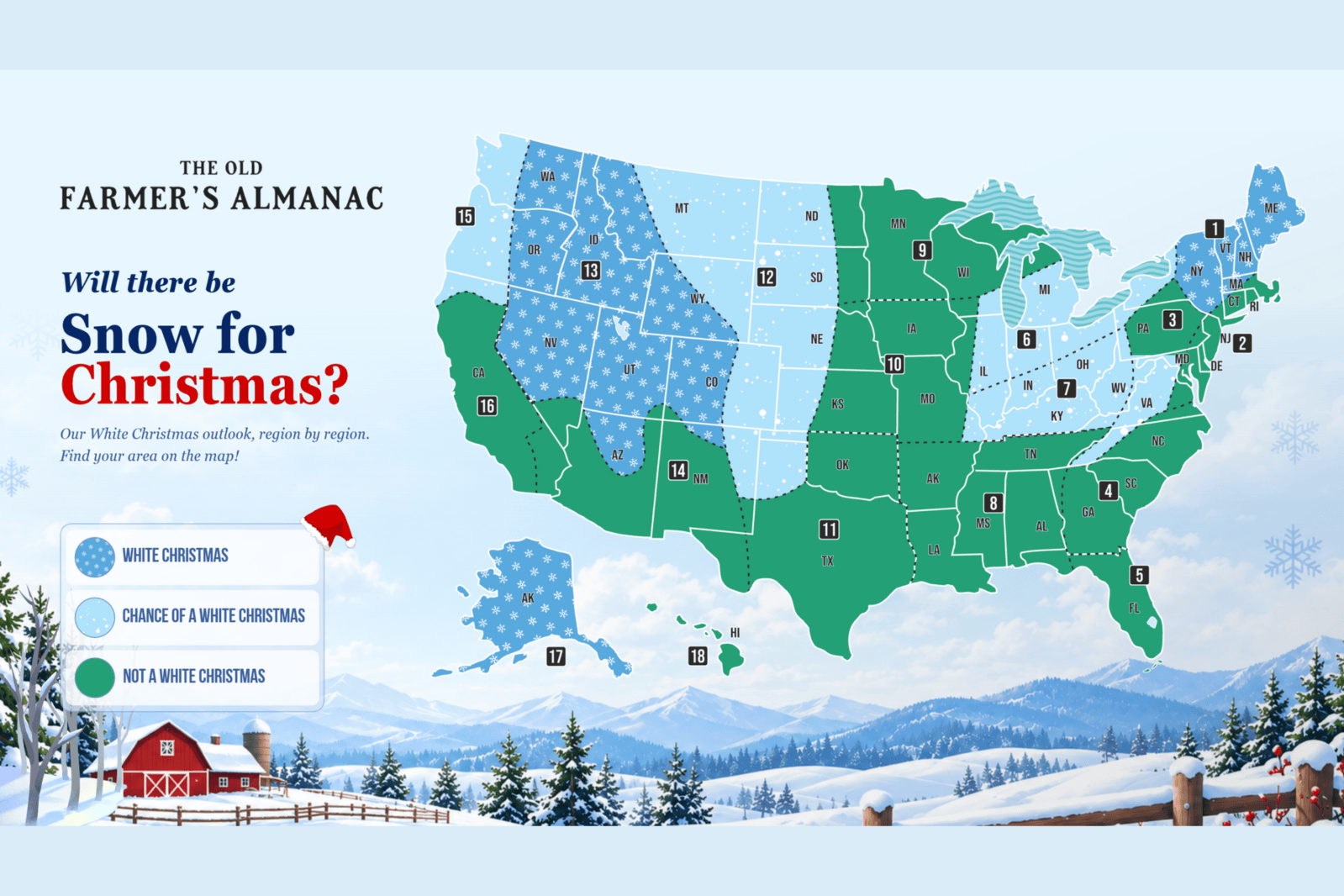
Americans dreaming of snow on Christmas morning might find their best prospects in three key areas. According to a new long-range forecast from The Old Farmer’s Almanac, snow is anticipated in 2026 for the Northeast, Intermountain region, and Alaska. Other areas, such as the Pacific Northwest, High Plains, Lower Lakes, and Ohio Valley, might also see snow, though the chance is less certain.
However, many regions in the South and central U.S. are less likely to see snow. Regions like the Atlantic Corridor, Southeast, Florida, Deep South, Upper Midwest, Heartland, Texas-Oklahoma, Desert Southwest, and Pacific Southwest are not expected to experience a white Christmas. Hawaii is also unlikely to get snow.
In the Appalachians, a split forecast shows northern areas missing the snow, while southern parts could have a possibility.
Understanding ‘White Christmas’
A ‘white Christmas’ means having at least 1 inch of snow on the ground by 7 am local time on December 25.
This definition from the National Weather Service indicates that snow doesn’t need to fall on Christmas Day specifically. Pre-Christmas snowfall that remains can contribute to a white Christmas.
Why Some Regions Are More Likely to Have Snow
Regions with higher chances typically align with areas predicted to have “above normal” snowfall this winter. This includes the Northeast, parts of the Appalachians, the Intermountain region, and Alaska. For instance, the southern Northeast is expected to see heavy snowfall in mid- and late December, potentially leading to snow coverage on Christmas Day.
In contrast, northern areas might experience below-normal snowfall overall, decreasing the likelihood of a white Christmas.
The Intermountain and Pacific Northwest regions are also predicted to have substantial snowfall. Yet, the Almanac provides a ‘chance’ rather than a firm prediction for these areas.
The Old Farmer’s Almanac: A Brief History
The Old Farmer’s Almanac, operating since 1792, offers long-range weather forecasts. Initially a resource for farmers and gardeners, it combines solar science, climatology, and meteorology, along with historical and current weather data, to create predictions.
The National Weather Service’s Climate Prediction Center also releases long-range climate outlooks. These include probabilities for temperatures and precipitation over varying timeframes.
The Almanac’s forecast presents early suggestions for December 25 snow, yet more precise predictions will be available as the date approaches.
Historical Snow Data
The regions forecasted for snow align with historical data. NOAA records reveal Minnesota, Maine, upstate New York, Idaho, and several mountain areas often experience snow on Christmas morning. Alaska is also known for frequently having snow.
It’s crucial to remember that while historical patterns can guide expectations, actual conditions depend on weather patterns closer to Christmas. The Almanac emphasizes that long-range forecasts highlight trends rather than exact conditions.
This outlook underscores potential conditions but may adjust as December arrives.