Discovery of Most Distant Quasar Pushes Cosmic Boundaries
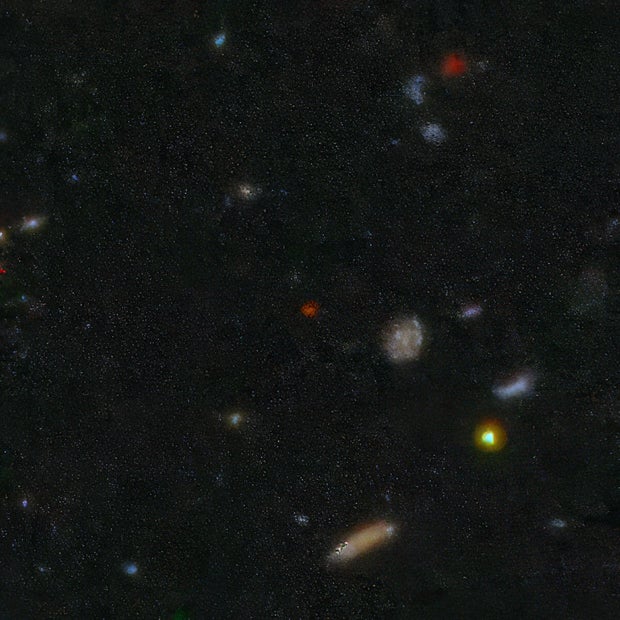
Scientists have identified the most distant quasar to date, marking a significant discovery from near the universe’s beginning. This quasar, the dense center of a galaxy with a black hole, formed approximately 630 million years after the Big Bang. This finding sets a new record in the 13.8-billion-year timeline of the universe, as reported by a team led by German researchers.
An image from the European Space Agency’s Euclid telescope, released November 24, 2026, captured this quasar, pinpointed as a red dot at its center. Julien Wolf from the European Southern Observatory, who spearheaded the study, expressed his excitement about this considerable leap in cosmic time. The discovery surpasses previous records by advancing nearly 40 million years, the largest progress made in almost a decade.
The Euclid telescope, launched in 2023, assists in exploring dark matter and dark energy within galaxies. These elements contribute significantly to the universe’s expansion. Finding such an early quasar is rare, said Wolf, especially given the large size of the black hole despite its relatively slow consumption of nearby materials.
The quasar is named Dun Aonghasa, inspired by a prehistoric stone fort on Ireland’s Aran Islands. Wolf’s personal connection to the fort, through his Irish wife and daughter, reflects a frontier offering vast exploration potential, akin to this newfound quasar.
Telescopes like Hubble and Webb, alongside Earth-based observatories, validated these findings. The Webb telescope revealed that the quasar’s black hole holds a mass equal to 360 million suns, a remarkable figure for such an early time in the universe’s history.
These findings, published in the journal Astronomy & Astrophysics, challenge current understandings of black hole formation. “Dun Aonghasa gives us a new timeline for the early universe,” explained Wolf. This discovery prompts questions about how a black hole of such mass existed so soon after the Big Bang.
As research continues at the cosmic dawn, Wolf cautioned that this record could be broken within months or endure for years.