Egyptian Archaeologists Uncover 2,300-Year-Old Cemetery
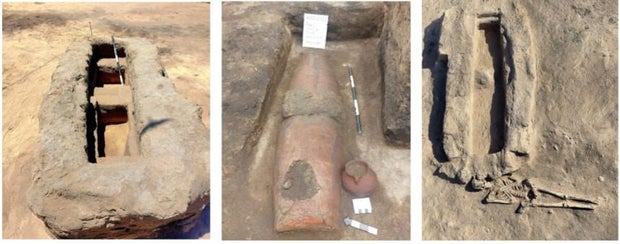
Cairo — Egyptian archaeologists have made a significant discovery in a Greco-Roman cemetery dating back over 2,300 years. The site, located at Tell Kom Aziza in the Nile Delta’s Beheira province, provides insight into funerary practices spanning six centuries, highlighting its historical significance.
The burials, ranging from 332 B.C. to 395 A.D., exhibit diverse practices. Nevine El-Aref, media adviser to the Minister of Tourism and Antiquities, emphasized the site’s transformation from a settlement into a cemetery during its long usage. “It is a unique example that shows the transformation of a settlement hub into a major burial ground spanning different ancient eras,” she stated.
Discoveries at the Tell Kom Aziza site include a variety of burial methods. These range from simple pit burials to graves lined with mudbricks and painted plaster coffins. Dr. Hisham El-Leithy, Secretary General of the Supreme Council of Antiquities, noted variations in burial orientations and hand positions of the deceased, such as folded hands, the “Osirian pose” with crossed arms over the chest, or arms aligned along the thighs.
Team head Khaled Abdel Ghany Farhat suggested the diversity in burials could indicate social differences, ritual variations, or developments within the same funerary tradition. Notable finds included the complete skeletal remains of two wild boars, linked to the deity Seth, associated with chaos and violence in ancient Egyptian mythology.
Mohamed Abdel Badi, Head of the Egyptian Antiquities Sector, explained the importance of boar remains at such a site, implying potential ritual significance. “Even though it’s not possible yet to determine with certainty whether these remains represent intentional animal burials, remnants of domestic and economic activity, or an element with ritual significance, their presence within this context requires linking the direct archaeological evidence with the cultural and religious significance of the boar in ancient Egypt,” he said.
Additional findings included pottery fragments spanning from the Egyptian Old Kingdom to the Greco-Roman period. These items, including amphorae and burial jars, suggest the site’s use over thousands of years.
Excavation efforts continue at the site to reveal more details about its history and development. El-Aref noted the ongoing work is critical to understanding patterns of human activity in the area and piecing together its rich past.