Forecasting Wildfire Smoke: Challenges and Uncertainties
Forecasting wildfire smoke behavior presents ongoing challenges due to the interplay between various elements such as burning fires, smoke dispersion, and rapidly changing weather patterns. Recent observations suggest that the coming days could be highly unpredictable.
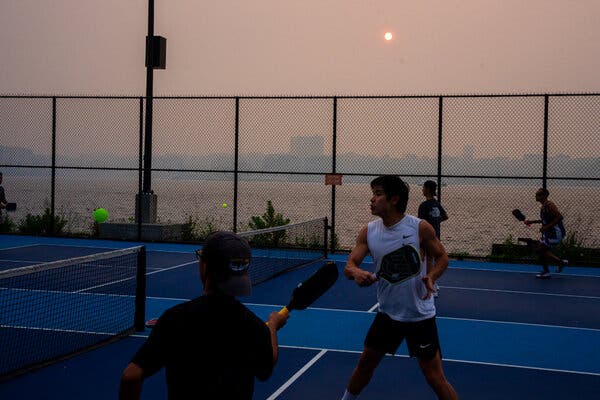
On Thursday, Manhattan residents, including pickleball players, experienced the impact of wildfire smoke. Although the smoke reduced early Friday, changes in weather patterns could lead to its return.
According to meteorologists, predicting smoke behavior is complex. Even with advanced computer weather models, accurately forecasting smoke behavior remains difficult as conditions change swiftly. Forecasters rely on observations of smoke, active fires, wind patterns, and atmospheric changes, any of which can affect predictions.
The behavior of wildfire smoke and other elements varies significantly. On some days, these factors are predictable, while on others, they are chaotic, complicating forecasts.
Weather Pattern Shift
The consistent weather pattern causing smoke drift from Canada to the United States is expected to shift on Friday. This change introduces more uncertainty for the weekend’s weather prognoses.
Challenge in Smoke Prediction
The primary challenge is estimating the volume of smoke released from wildfires. On Tuesday, smoke concentrations were notably thicker due to favorable conditions for rapidly growing wildfires. These conditions allowed fires to create their own weather patterns and inject substantial smoke into the atmosphere.
Accurate forecasts are hindered by the chaotic nature of variables involved in wildfire smoke behavior, emphasizing the reliance on real-time observations and adaptive forecasting methods.