Latino Demographics Shift in Chicago
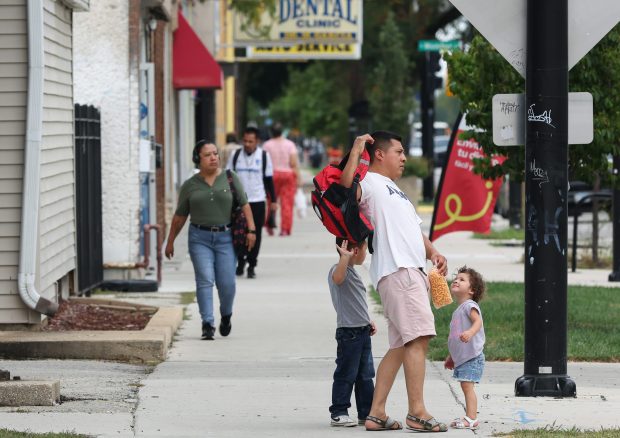
For many years, Little Village has served as a cultural center for Latino Chicago. Thousands gathered at the 26th Street corridor for its 55th annual Mexican Independence Parade, showcasing this role. However, a recent University of Illinois Chicago study reveals that neither Little Village nor Pilsen houses Chicago’s largest Latino population. The title belongs to a neighborhood about 8 miles north: Belmont Cragin on the Northwest Side.
According to the UIC’s Great Cities Institute, Belmont Cragin has the largest Latino population in Chicago. Of the nearly 802,000 Latino residents citywide, over 57,000 live in Belmont Cragin, accounting for about 80% of its population. The study highlights a community that represents nearly 30% of Chicago’s population.
“For us, it’s about taking a comprehensive look at who the Latino community actually is. I think many times, we think of the Latino community as a single issue,” said Oswaldo Alvarez, executive director of the Illinois Legislative Latino Caucus Foundation.
The neighborhood of Belmont Cragin, spanning less than 3 miles, shows the changing demographics. Homes are decorated with flags from Mexico, Argentina, and Colombia. Along Fullerton Avenue, multilingual signs in storefronts reflect a community with Latin American roots.
Fullerton Avenue tops Chicago’s commercial corridors, generating roughly $181 million in taxable sales in 2024. It surpassed the “Mexican Magnificent Mile” on 26th Street, which produced nearly $177 million and had the highest year-over-year increase in sales according to the study.
Mexican residents remain the largest group in Belmont Cragin, but the study notes significant Puerto Rican, Central American, and South American populations. Luisa Rodriguez, who operates Niko’s Multiservices and Cell, observes this diversity. Her customers hail from countries such as Guatemala, the Dominican Republic, and Honduras.
The study highlights demographic shifts across Chicago. The Southwest and Southeast areas remain predominantly Mexican, while the Northwest Side includes diverse populations from countries like Ecuador and Colombia. Austin, a primarily Black neighborhood on the West Side, has seen significant increases in Latino residents.
Neighborhoods like Garfield Ridge and Ashburn have recorded increased Latino populations, challenging traditional demographic perceptions. On the other hand, some long-established communities, including Logan Square and Pilsen, have seen declines in their Latino populations.
Various factors, such as housing costs and homeownership, contribute to the movement of Latino residents to areas like Austin and Belmont Cragin. Gentrification pressures with high rent prices and low housing stock push residents away from central city areas. Almost half of Latino renters in Chicago are considered “cost-burdened,” spending at least one-third of their income on housing.
“What we’ve been seeing, especially on the Northwest Side, in Logan Square and Humboldt Park, you’ve seen gentrification impact the Latino communities at a greater rate than other communities,” Alvarez explained.
While rising costs are displacing some families, others find opportunities to buy homes elsewhere. In 2024, Latino homeownership reached over 80% in Ashburn and Garfield Ridge. Latino borrowers dominated new mortgages in areas like Gage Park.
The report documents a growing Latino middle class in Chicago. Nearly one-third of Latino households now earn at least $100,000 annually, up from 20.7% a decade ago. The number of Latino households earning six figures rose by nearly 35,000 during this period. Educational attainment has also improved, with more Latino adults holding bachelor’s degrees. Employment in sectors like management and science has increased.
Despite these advancements, the report advises caution against any assumptions that the Latino working class is vanishing. Almost 60% of Latino employment remains in traditionally lower-paying industries.
“My hope is that it provokes questions, that it provokes a lot of questions of cross-issue areas and that it challenges the way we are thinking or boxing what the Latino community actually is,” Alvarez concluded.