Opportunity to Witness Northern Lights Amid Solar Activity
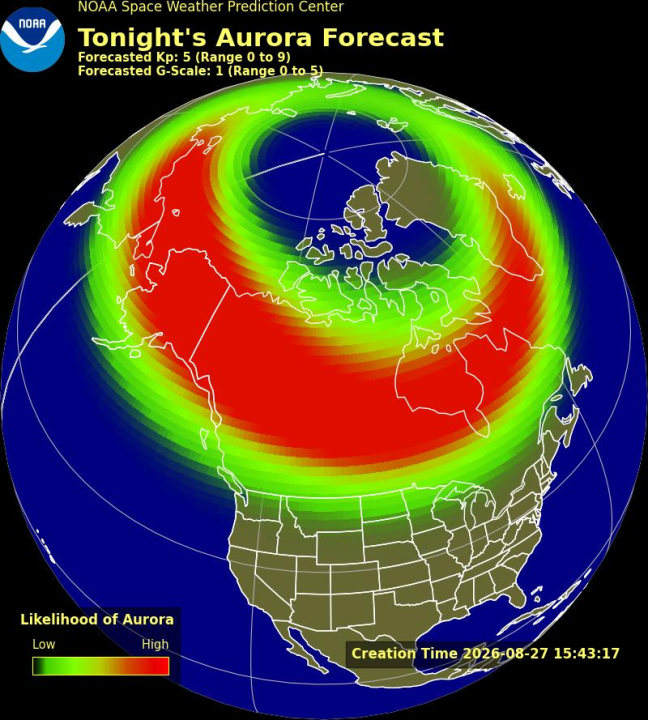
In addition to this week’s blood moon lunar eclipse, there is a potential to view the northern lights due to increased solar activity. The phenomenon, caused by solar material interacting with Earth’s atmosphere, can trigger geomagnetic storms, leading to these dazzling displays.
This week, the sun expelled material that might ignite auroras. The Space Weather Prediction Center (SWPC) of the National Weather Service issued geomagnetic storm watches for Thursday and Friday due to a coronal hole high-speed stream (CH HSS). On Wednesday, these watches were extended to Saturday, following coronal mass ejections (CMEs) from the sun.
Reports from the SWPC suggest that storm conditions could intensify on Friday and Saturday. The resulting energy from these solar activities may cause the northern lights to appear in northern areas of the U.S.
The SWPC forecast indicates that geomagnetic storm conditions might strengthen around 5 p.m. EDT on Thursday and persist past sunset, which is ideal for viewing the auroras. These conditions might reach a moderate G2 level between 8 p.m. and 11 p.m. EDT on Thursday. At this level, the northern lights could be visible as far south as New York and Idaho.
The aurora forecast for Thursday gives the best chance of sighting to most of Canada and Alaska. Near the Canadian border, there is a slim chance of seeing the lights, potentially visible only along the northern horizon.
While the storm’s intensity might decrease as Thursday night progresses, the SWPC predicts a resurgence around 5 p.m. EDT on Friday, with conditions possibly strengthening again between 8 p.m. and 11 p.m. EDT.
SWPC’s forecast ends at 11 p.m. EDT on Saturday, leaving uncertainty about further opportunities for aurora viewing. The unpredictability of how space material interacts with our atmosphere adds another layer of uncertainty.
For those eager to see the aurora, looking towards the northern horizon improves chances. If visibility is compromised, using a smartphone may help, as modern digital camera sensors can detect the aurora’s colors more effectively than the human eye.