Pentagon Discontinues Use of ‘Operation Epic Fury’ Name Post-Conclusion
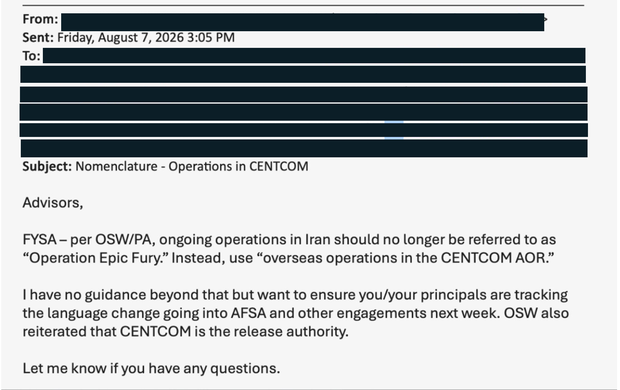
Washington — An internal Air Force email from August, obtained by CBS News, reveals that the Pentagon instructed personnel to stop referring to ongoing U.S. military actions in Iran as ‘Operation Epic Fury.’ This directive came three months after the Trump administration announced its conclusion.
The Pentagon confirmed to CBS News that Operation Epic Fury officially ended on May 5. On that day, Secretary of State Marco Rubio told reporters at the White House that the operation was over, stating, “The president notified Congress — we’re done with that stage of it. We’re now on to this Project Freedom.” Four days prior, President Trump informed Congress that hostilities had ‘terminated.’
The end date of Operation Epic Fury had been kept undisclosed by the Pentagon and U.S. Central Command for months. Nonetheless, skirmishes between the U.S. and Iran have persisted, albeit with pauses like the ceasefire that began in early April.
Questions Raised Over Military Operations
The official end date prompts questions regarding how the Pentagon categorizes service members killed and wounded after Operation Epic Fury terminated, or why the guidance on nomenclature for ongoing U.S. military operations was issued months after the official end date.
In early August, top public affairs officers were directed to tell military leaders not to use ‘Operation Epic Fury.’ Instead, they were to employ broader terms, such as ‘overseas operations in the [U.S. Central Command Area of Responsibility],’ directed by Sean Parnell, the Pentagon’s chief spokesman, through Defense Secretary Pete Hegseth’s central public affairs office.
Military sources, speaking anonymously, vouched that this guidance was not exclusive to the Air Force but was disseminated throughout the entire Defense Department in August and September.
Operation Documentation and Casualties
Historically, the U.S. military has published clear start and end dates for named operations, setting a public record of American military involvement. For example, Operation Enduring Freedom in Afghanistan spanned from October 7, 2001, to December 31, 2014, transitioning then into Operation Freedom’s Sentinel. These dates help determine campaign phases and eligibility for military awards and provide Congress and the public with the means to track military engagements abroad.
Rubio is noted as the sole Trump official to publicly declare Epic Fury’s conclusion, though he did not specify May 5 as its ending. On the same date, Hegseth held a briefing at the Pentagon, distinguishing it from the newer Project Freedom, a defensive maritime mission to protect commercial shipping through the Strait of Hormuz. He mentioned Epic Fury in past tense, without clearly stating its end. The last Pentagon press briefing on the Iran conflict was on May 5.
President Trump paused Project Freedom on May 5 to negotiate with Iran. The broader conflict with Iran persists, though military action against Iran was officially reiterated in a notice to Congress on July 7.
Reclassification of Casualties
Despite ending Epic Fury, the U.S. military continues missions linked to the conflict. As observed in July on the Defense Department website, service members killed in July were initially listed as Epic Fury casualties, two months after it ended. Among those killed were 1st Lt. Tyler James Feehan, Staff Sgt. Angel Rampersad, and Pfc. Isabella Gonzales, whose deaths resulted from an Iranian missile strike in Jordan. Staff Sgt. Michael Emmanuel Swinton died in a separate incident in Iraq shortly after.
Soon, these service members were reclassified under a new ‘overseas operations’ category on July 25. This reduced the reported number of deaths under Epic Fury from 18 to 14. Inquiries from news outlets led to Sean Parnell attributing the categorization error to a ‘temporary data disruption.’
A Pentagon official clarified, “Since Operation Epic Fury concluded, the Department classifies casualties as overseas operations within the CENTCOM area of responsibility.”
Presently, the Pentagon’s Defense Casualty Analysis System records five service members wounded in June and one killed in July under Operation Epic Fury. The reasons behind their current categorization, despite the official end in May, remain unspecified.