Public Sentiment on the Iran Conflict and U.S. Policies
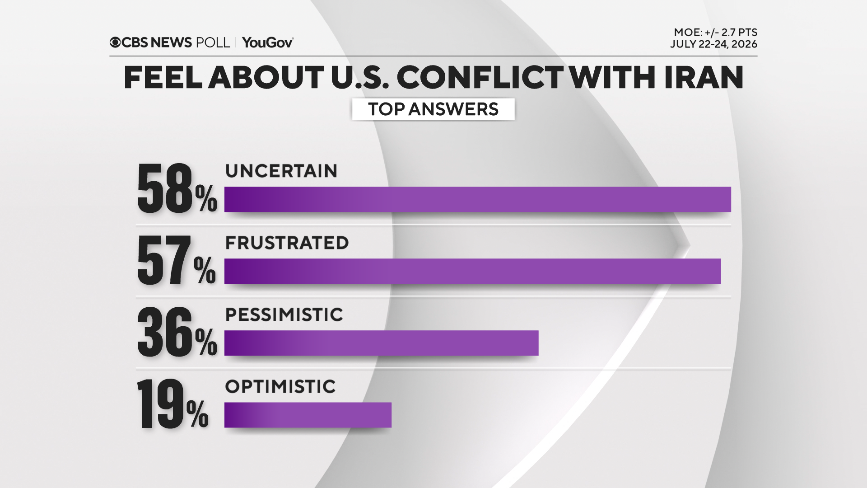
The ongoing conflict with Iran has left the public expressing three main concerns. First, there is a perceived lack of clarity regarding daily developments in the Strait of Hormuz. Second, there are key objectives the U.S. could pursue now that involvement in the conflict has deepened. Lastly, many feel the conflict is not proceeding well.
Amid escalating fighting, most Americans describe their feelings as uncertain and frustrated. Most foresee the conflict stretching out over months or even years, believing it has been more challenging than the Trump administration expected.
Public Goals and Preferences
Public support has consistently focused on three primary goals: reopening the Strait of Hormuz as gas prices rise, stopping Iran’s nuclear program, and preventing regional threats from Iran. Despite these goals, many Americans doubt an easy resolution, anticipating a prolonged conflict.
There is a prevailing preference for ending the war instead of seeking more concessions from Iran. After a deal to end the conflict failed, support for an immediate end has declined slightly, influenced mainly by Republican sentiments. Initially, Republicans supported the president’s approach for a ceasefire agreement announced in June. However, since the deal collapsed, they now advocate for continuing the conflict.
For about one-third who prefer seeking additional concessions, the stated goals are particularly significant. The desire to end the war varies with age, with younger individuals more inclined to favor ending the conflict than those over 65.
Uncertainty and Perceptions
The predominant uncertainty stems from unclear daily developments in the Strait of Hormuz, an issue persisting for numerous weeks. Many believe President Trump does not adequately address this, often presenting a more favorable picture than reality.
Overall perceptions of the war have declined, with opinions on who holds the advantage being unclear. While some perceive the U.S. has gained an edge compared to May, many remain uncertain. Approval of military actions is stable, though generally negative.
Domestic Situation and Economic Concerns
Domestically, the situation has not changed significantly. For most people, incomes are not keeping pace with inflation. The public criticizes the president for focusing too little on reducing prices and too much on unpopular tariffs and changes in Washington, D.C. construction projects. About half consider gas prices a challenge, though concerns have slightly eased.
Those hardest hit by economic issues are especially critical of military action. Economic views are predominantly negative but stable. The majority of those falling behind due to inflation oppose new tariffs.
The president’s approval ratings on handling Iran remain consistent with previous measures and are lower than his general approval ratings, which have risen slightly since June. Public sentiment reveals no clear preference for Democrats over Republicans on Iran policies. Those unsure or critical of both parties display greater uncertainty about the conflict.
The survey was conducted with a representative sample of 2,193 U.S. adults from July 22-24, 2026. The sample was weighted to reflect national demographics and past voting behavior. The margin of error is ±2.7 points.