Spain Installs Sea Barrier Amid Ceuta Border Crisis
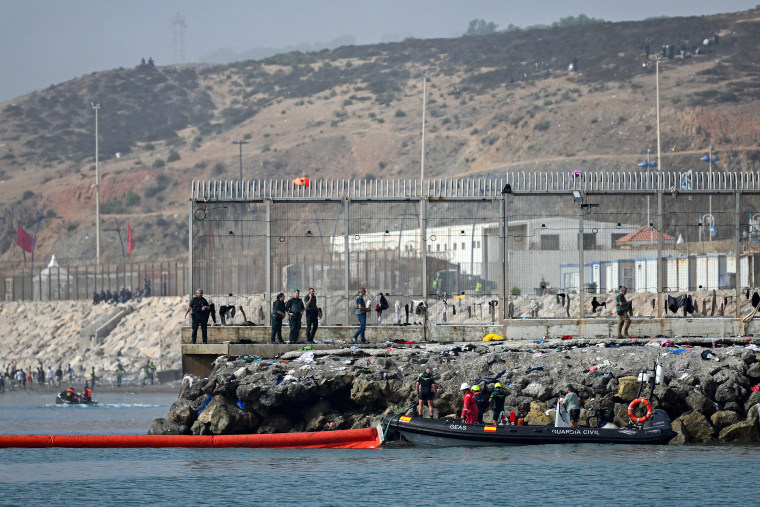
CEUTA, Spain — Spain has announced the installation of a 500-meter containment barrier along the sea border between its North African territory, Ceuta, and Morocco. This move follows a significant breach by approximately 50,000 to 60,000 migrants earlier this week. The Spanish government reported that the death toll from the incidents reached 67, involving drownings and stampede-related deaths as they crossed a breakwater barrier. Authorities in Ceuta informed Sky News on Saturday that 86 individuals have died.
Spanish Prime Minister Pedro Sánchez criticized some European Union leaders for their reactions to Ceuta’s events. He stated that calls for Spain’s suspension from the EU’s Schengen zone were rooted in ‘prejudice, fake news, ignorance, or political interest.’
As several exhausted migrants swam to Ceuta’s Tarajal beach on Saturday morning, soldiers escorted them back to the border. Spain’s Interior Ministry states that most of those who entered have returned to Morocco. Interior Minister Fernando Grande-Marlaska emphasized Spain’s firm stance against lawbreakers during a press event in Ceuta on Saturday. He highlighted the need for an evaluation between Spain and Morocco on the incident, citing cooperation as vital for managing the situation within 24 hours. ‘Morocco is not a threat to Ceuta, or the rest of Spain. It is a reliable partner,’ Marlaska noted.
A Spanish Guardia Civil boat deployed a pneumatic barrier in the water near the border to enhance security after unauthorized crossings from Morocco into Ceuta. — Jorge Guerrero / AFP via Getty Images
EU Leaders Seek Coordinated Response
Leaders from 22 EU countries have called for a joint response to the Ceuta situation. A letter from the Danish prime minister’s office urged EU officials to organize an immediate videoconference of the bloc’s interior ministers. The letter stresses that uncontrolled mass migrations and hybrid threats could foster the notion that illegal entries into the EU might become legal stays. Such perceptions could lead to more attempts, weakening trust in the common migration policy and impacting all member states.
Signatories of the letter include Italy, Denmark, Austria, Belgium, Bulgaria, Cyprus, Croatia, the Czech Republic, Estonia, Finland, Germany, Greece, Hungary, Latvia, Lithuania, Malta, the Netherlands, Poland, Romania, Slovenia, Slovakia, and Sweden. Prime Minister Sánchez has also requested a videoconference to establish a unified approach, emphasizing the shared responsibility of securing EU borders. He criticized countries calling for Spain’s temporary exclusion from the Schengen Area.
Italian Premier Giorgia Meloni threatened to suspend Italy’s Schengen agreement with Spain, reinstating border controls for people arriving from Spain by air and sea. Sánchez condemned this move as ‘selfish, polarizing, and unlawful.’
Migrant Returns to Morocco
Hundreds of migrants, who recently entered Ceuta from Morocco, returned, sharing with an Associated Press reporter their decision to leave due to harsh conditions. Migrants moved back through a small breach in the border fence, with Moroccan police observing. Most migrants were from Morocco, with some from sub-Saharan Africa.
The returning migrants recounted difficult experiences in Ceuta. Ouail Lamzeiz mentioned spending eight days there before deciding to return, citing a lack of food and no assistance. Salah Eddine El Arrage returned after alleging police mistreatment. Many, like Othmane El Merzoug, struggled for basic needs and connection with families for support.
The border road bore signs of recent unrest with burned vehicles and police barriers guiding traffic. Ceuta’s President Juan Jesús Vivas remarked on the city’s disruption and emphasized the need for a complete resolution.
In the Moroccan city of Tangier, the primary railway station bustled with returning migrants, some resting on the ground. Abdalah, an aspiring migrant, recounted difficulties in attempting the crossing and finding sustenance near the border.
Despite the challenges, some migrants like Mohamed Hatri remain intent on staying in Ceuta, stating resilience despite the lack of food provisions. ‘They’ve closed everything down to force us to return, but we want to stay, hungry or not,’ he asserted.