Suburban School Districts Face Budget Challenges Due to Rising Diesel Prices
Suburban school districts that manage their own bus fleets are confronting significant budget challenges. This is due to the spike in diesel prices this fall, driven by global supply worries stemming from conflicts in Iran and Ukraine. Additionally, a power outage at the ExxonMobil refinery in Joliet on September 13 contributed to the surge. On September 23, diesel prices in Illinois reached a record average of $6.83 per gallon, according to AAA. While prices have slightly dipped to $6.58 per gallon, the financial strain persists.
Naperville Unit District 203 operates over 120 diesel-powered school buses to serve approximately 16,000 students. Lisa Xagas, the assistant superintendent of strategy and engagement for District 203, revealed that the district anticipates spending an additional $300,000 on fuel during the 2026-27 school year if current diesel prices continue. Efforts to optimize bus routes saved the district an estimated 900 miles per day. Xagas stated, “Right now we are in the phase where we are watching the price of diesel closely and analyzing the impact.” The district has not yet considered canceling field trips or transportation services for events.
The district has allocated $15.6 million towards transportation in its 2026-27 budget. This constitutes about 4.2% of its overall budget, which totals more than $370 million. Despite having reserve funding to cover the short-term fuel price hike, the district faces a budget deficit of $3.9 million, partly due to declining enrollment. Tough decisions are anticipated during the 2027-28 budget planning process if diesel prices remain elevated. Although Naperville 203 has ordered electric buses over a year ago, there are no current plans to purchase additional non-diesel buses.
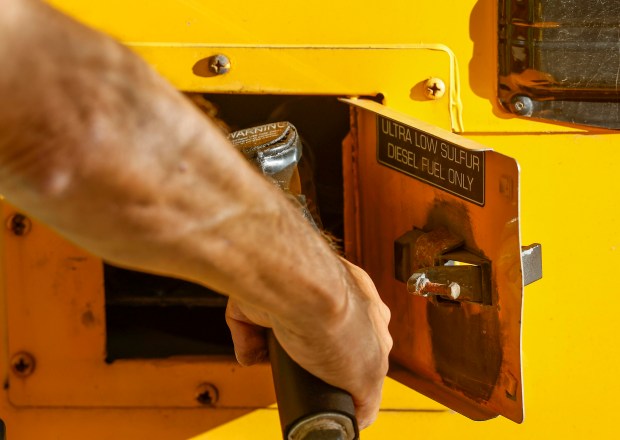
A school bus driver refuels with diesel in Elgin on October 13, 2026.
Elgin Area School District U-46, serving over 33,000 students with 331 diesel-powered buses, is also assessing the impact of diesel prices. The district has allocated $2.6 million towards fuel expenses for the 2027 fiscal year. Marcy Murphy, director of transportation, mentioned that the district is examining options such as electric and natural-gas buses.
Palatine-Schaumburg Township High School District 211 transitioned from diesel to propane before the 2018-19 school year. Its fleet now includes 80 propane-powered buses. Chief Operating Officer Lauren Hummel noted the district pays $1.15 to $1.40 per gallon for propane—over $5 less than diesel. She cited benefits such as reliability in cold weather and reduced noise. Despite exploring electric buses, the district chose propane due to higher upfront and maintenance costs associated with electric buses.
St. Charles Community Unit District 303 shifted from diesel to gasoline-powered buses around the same time as District 211. Now operating 12 diesel buses, the district may delay nonessential transportation expenses if diesel prices remain high. Changes will focus on minimizing impact on service quality and safety.
A driver returns to her vehicle at the Elgin Area School District U-46 bus yard.
Susan Mudd, who leads the Diesel Pollution Reduction Initiative at the Environmental Law & Policy Center, advocates for a shift to electric buses due to affordability and environmental benefits. Although propane buses have advantages over diesel, they emit more carbon monoxide. The Environmental Protection Agency’s Clean School Bus Program has distributed $2.6 billion to support districts shifting to lower-emission alternatives.
Naperville 203 faces financial pressure as state funding has been insufficient. State law mandates an 80% reimbursement of fuel expenses, but Naperville 203 received $2.3 million less in fiscal year 2026 and more than $8.4 million less in total over the past five years. Patrick De Haan from GasBuddy mentions diesel prices may decline slightly with resumed operations at the Joliet ExxonMobil plant. Longer-term relief depends on global tensions in regions like Ukraine and Iran.