Can AI Data Centers and Agriculture Coexist Amid Water Concerns in the Great Plains?
Balancing AI Development and Water Resources
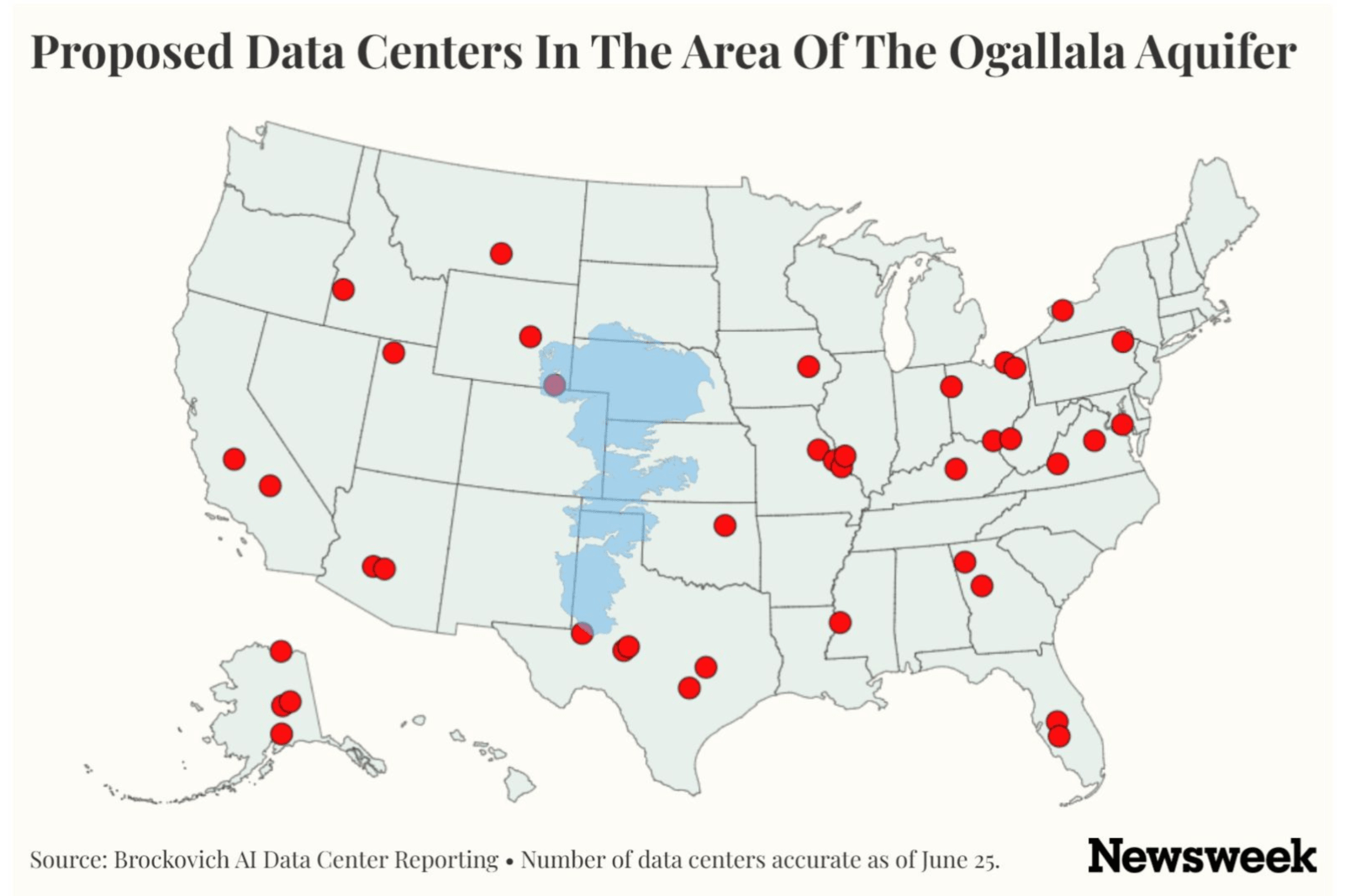
The rapid growth of AI data centers in the Great Plains is raising critical questions about their impact on the Ogallala Aquifer, a vital groundwater reserve supporting agriculture and communities. With new mapping by Brockovich AI Data Center Reporting, there are concerns about proposed and under-construction AI facilities situated near or directly above this crucial water source.
Local governments in Texas and Wyoming are tasked with evaluating the economic benefits of AI investments against long-term water availability concerns. The Fermi Project Matador in Amarillo, Texas, witnessed testimony on water conservation efforts before Texas House Natural Resources Committee.
In Tom Green County, Texas, for instance, commissioners rejected a proposed moratorium on data center development following public protest against Beacon’s Dove Creek project. There is a growing call for stricter state regulations on high-volume water usage by data centers.
AI Projects Near the Aquifer
Several large AI-focused campuses are planned or under construction near the Ogallala Aquifer in Texas and Wyoming, drawing scrutiny from stakeholders concerned about water impact.
- Texas Critical Data Centers, Ector County, Texas: Spanning 438 acres, this site is co-developed by New Era Energy & Digital and Primary Digital Infrastructure, with construction expected to begin later in 2026.
- Microsoft Cheyenne Expansion, Cheyenne, Wyoming: Microsoft has announced plans to acquire 3,200 additional acres to enhance infrastructure with a $68M investment.
- Prometheus Hyperscale Casper, Natrona County, Wyoming: A 1.5 GW campus is planned east of Casper, targeting a 2028 operational timeline.
- Skybox, San Angelo, Texas: Proposed on 350 acres of city-owned land.
- Beacon Data Center Dove Creek, San Angelo, Texas: This project remains in planning stages pending study results.
Existing Projects and Environmental Considerations
Four data centers are already under construction over the Ogallala Aquifer in Texas and Wyoming, intensifying concerns.
- Crusoe Project Jade, Laramie County, Wyoming: A 1.8-gigawatt AI data center is being built, with expected completion of initial buildings by 2027.
- Related Digital Cheyenne, Laramie County, Wyoming: Utilizing efficient air-cooled systems, this $1.2 billion campus minimizes water use.
- Fermi Project Matador, Amarillo, Texas: An 11 GW campus with ongoing construction challenges and conservation concerns.
- Aligned Project Caprock, Abernathy, Texas: Construction commenced in April 2026, with first building due in early 2027.
Differences in Water Cooling Technologies
Data centers vary in cooling technologies, each with unique environmental impacts. Facilities employing air-cooled systems, like Related Digital’s Cheyenne campus, emphasize minimal water use. In contrast, liquid-cooling systems, though energy-efficient, entail varying water consumption based on design.
Such distinctions underscore the significant environmental footprint, contingent not only on location but on engineering design choices.
The Ogallala Aquifer: A Critical Resource
Stretching beneath eight states, the Ogallala Aquifer is pivotal for U.S. irrigation, supporting substantial agricultural production. Decades of withdrawals have drastically lowered water levels, posing challenges.
According to Sudeep Pasricha, a professor at Colorado State University, water loss rates in some regions are alarming, with depletion occurring faster than natural recharge. Scientists emphasize the aquifer’s slow replenishment rate, forecasting lengthy recovery periods.
Development Pressure in the Great Plains
Despite water concerns, the Great Plains remain attractive for AI infrastructure, driven by factors like low land costs, access to transmission infrastructure, tax benefits, and fewer land-use constraints compared to coastal markets.
Data center site selection integrates multiple factors, but environment impacts are dictated more by design than merely geographic location.
AI facilities necessitate advanced cooling systems. Designs range from groundwater reliance to less water-intensive air cooling and closed-loop systems.
Rising Water Consumption Concerns
The demand for water in hyperscale facilities varies. Some consume minimal amounts, while others significantly impact small community water needs. Pasricha reported facilities using millions of gallons daily.
Overall, U.S. data centers consumed about 17 billion gallons of water for cooling in 2023, with direct and indirect footprints expected to grow with AI infrastructure expansion.
Engineering Choices: Evaporative vs. Water-Saving Alternatives
Evaporative cooling systems can lose significant water through evaporation. Alternatively, water-saving systems like air cooling and closed-loop configurations offer sustainable options, though they come with higher energy or capital costs.
Comparisons among facilities like Related Digital’s Cheyenne site and other unconfirmed projects indicate varying environmental impacts based on technology choices.
Indirect Water Footprints of Facilities
On-site water consumption is not the sole concern. Indirect footprints from electricity generation, reliant on water-intensive cooling, complicate impact assessments.
Effective evaluations encompass on-site practices and wider infrastructure dependencies.
AI’s Increasing Infrastructure Demand
Research by Shaolei Ren highlighted the substantial water footprint of AI computing workloads. Across billions of interactions, demands grow significant enough to warrant attention.
Pasricha warns cumulative impacts may outweigh single facility concerns, potentially creating material effects across groundwater systems.
Evolving Community Concerns
Water availability is now a pressing political issue, prompting queries regarding water sourcing, cooling technologies, and sustainability from Texas and Wyoming communities.
San Angelo’s local officials deliberate infrastructure tied to AI projects, reflecting tension between development prospects and resource uncertainties.
Potential Consequences
Decisions will influence irrigation capacity, crop production, and food prices. Long-term aquifer depletion could reshape agriculture and economies.
Pasricha cautioned about high-risk decisions regarding data center placements in semi-arid regions with declining aquifers.
Final Considerations
The focus extends beyond water consumption to technology, location, and community equilibrium between growth and resource preservation.
With AI projects proposed near the Ogallala Aquifer, local officials face urgent decisions on adapting infrastructure to mitigate impact on this crucial resource.