Echoes of History: Immigration Sweeps Stir Memories of Past Injustices
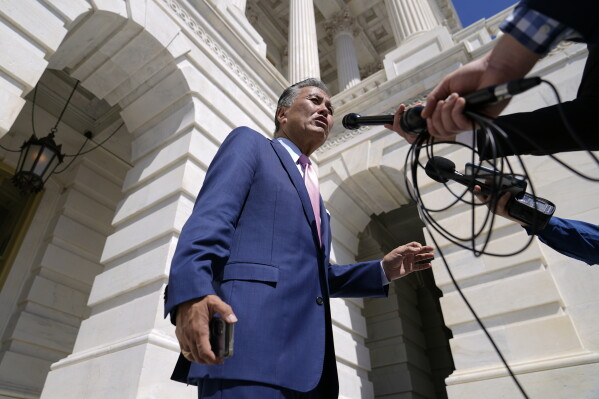
In Southern California, a congressman returned home last Fourth of July, encountering disquieting accounts from residents. Immigration patrols had been sweeping through communities. One worried constituent even began carrying a passport for proof of legal residency.
Rep. Mark Takano found unsettling parallels in these stories. His American-born parents, as children, suffered forced relocation during World War II. Back then, Japanese Americans were labeled as threats, similar to claims made today about immigrants.
During an interview with The Associated Press, Takano reflected on the circumstances his family faced. His father was two and his mother one when they were deemed enemy aliens and deemed dangerous to national security. They were sent to incarceration camps.
He noted, “Similar arguments have been made by this administration—that immigrants pose a grave danger to our country and it’s for the security of our country that we’re doing this.”
Takano addressed reporters at a Congressional Progressive Caucus news conference, sharing these insights from Capitol Hill. His statements coincided with President Trump’s immigration actions and a broader national conversation.
Trump’s Immigration Efforts Face Scrutiny
President Trump vowed the largest deportation effort in U.S. history. Americans have witnessed these actions, especially following protests. Notably, the deaths of U.S. citizens Renee Good and Alex Pretti in Minneapolis fueled public outcry.
The White House overhauled leadership at the Department of Homeland Security. New Secretary Markwayne Mullin aimed to reduce media focus. However, Trump faced pressure from conservative factions to continue deporting a million people annually.
Republican allies in Congress supported such efforts with significant funding. In response, Takano drew from his family’s experiences and the eventual redress of Japanese Americans to challenge these immigration policies.
“We look back on that era of history as a shameful one,” Takano stated, condemning past political failures.
A Personal Family History
Before Congress, Takano taught high school history. He grew up in Southern California, learning of his family’s past. His grandfather, Isao Takano, immigrated from Hiroshima, marrying Kazue Takahashi, a U.S. citizen. They settled in Bellevue, Washington, establishing a produce business.
During the war, after Pearl Harbor, they were among 120,000 Japanese Americans forcibly relocated. Takano’s father was two when his family was interned at Tule Lake in California. His mother, a year old, was moved to Heart Mountain in Wyoming.
Takano recalled, “People are being swept up in anti-immigrant detentions, similar to my family’s past.”
He questioned how future Americans might view the Trump-era detention facility in Florida, likened to Alcatraz.
Seeking Justice Like the Past
Takano remembered visiting family land with his father. He learned about relatives who fought in the Army’s 442nd Regimental Combat Team. His own father supported redress efforts, collecting donations for their campaign.
In 1988, the Civil Liberties Act was passed by Congress, supported by Republican President Ronald Reagan. It acknowledged past injustices and provided $20,000 to each detainee. Takano’s parents received an official apology and compensation.
Discussions in Congress persist about a similar redress for those affected by recent immigration enforcement. Takano believes, “Remarkably the country did come to realize the mistake. We’re living through another era of mistakes and we can come out of this stronger.”