Government Documents Reveal True Motive Behind Controversial Chicago Raid
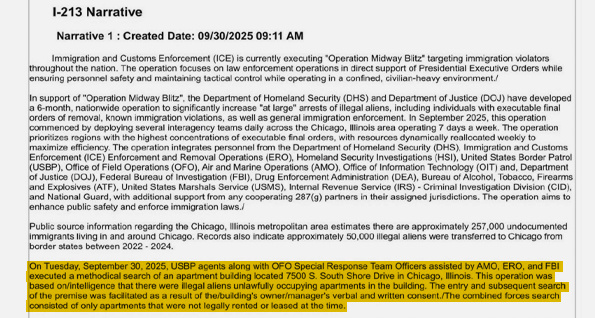
For months, the Trump administration claimed their late-night raid on a Chicago apartment complex was due to intelligence about the Venezuelan gang, Tren de Aragua, occupying the building. However, officials have not provided proof of this claim. Recent documents indicate the actual reason was more mundane: allegations of immigrants squatting in the complex. The landlord had allowed federal officials, who were already focused on targeting immigrants in Chicago, to search the property.
The arrest records of two out of the 37 immigrants detained that night, included in a motion filed as part of a federal consent decree, shed light on the operation’s motivations. These records reveal that agents received both verbal and written permission from the owner/manager to enter and search the complex. They cited intelligence of ‘illegal aliens unlawfully occupying apartments,’ focusing on units not legally rented at the time.
This narrative appears unchanged in the arrest reports for a Venezuelan and a Mexican man. Mark Fleming, an attorney with the National Immigrant Justice Center, stated that this operation was about supposed illegal occupancy by immigrants, which diverges significantly from the initial story shared by authorities.
The U.S. Department of Homeland Security (DHS) records don’t mention Tren de Aragua, despite officials citing the gang’s presence as the raid’s justification. The government presented the arrests as a victory against terrorism, claiming two detainees were gang members, without providing evidence. ProPublica obtained documents showing that the raid’s true motive was to address alleged squatting by immigrants.
Even four months after the raid, federal prosecutors have not pressed any criminal charges. ProPublica interviewed 15 of the detained immigrants, with all denying any gang ties. While acknowledging some criminal activity in the area, including a murder, no one knew of gang members living there. The arrest records form part of a broader litigation concerning whether the government violated a 2022 consent decree limiting warrantless arrests. Although the decree remains active, the government continues challenging it.
Government lawyers have admitted in court that many immigrants detained last year might have been improperly arrested. Following a court order, the DHS has been supplying administrative arrest records to lawyers, who demand the release of some immigrants or the lifting of restrictions on those already out. This includes the Venezuelan and Mexican men taken during the raid.
In their motion, immigrant rights attorneys argued that the government’s characterization of immigrants as flight risks during the raid was unfounded. They cited baseless factors like ‘willful disregard for others’ property’ and ‘attempt to flee from law enforcement,’ which conflicted with arrest narratives. More arrests that night might have violated the consent decree, though current cases under review only concern those still within the U.S.
Many immigrants detained during the South Shore raid eventually faced deportation or withdrew efforts to stay. Property owner Trinity Flood and the management company at the time, Strength in Management, did not comment on the matter. Flood and Corey Oliver, the management company owner, have continually declined interviews and denied any involvement in the operation.
A DHS spokesperson reaffirmed that the raid was lawful, referencing the arrests of two individuals allegedly linked to a Foreign Terrorist Organization. From early on, suspicions arose whether Flood and her manager had tipped off authorities to remove squatters. The property had failed city inspections consistently in the two years leading up to the raid.
State authorities recently launched a housing discrimination investigation into claims that Flood and her management company collaborated with federal agents to force out Black and Hispanic tenants. State officials highlighted how building management blamed Venezuelan tenants for lacking essential services and repairs, using stereotypes of gang affiliations to stigmatize foreign-born tenants. Post-raid, management workers disposed of tenants’ belongings, further clearing the apartments. State officials await responses from Flood and Strength in Management regarding the ongoing investigation.
Some Venezuelan immigrants detained expressed outrage upon learning of the property owner and manager’s involvement. One tenant, Jean Carlos Antonio Colmenares Pérez, spoke of feeling unjustly treated despite fulfilling rent obligations. He spent over two months in federal custody before deportation.
Another detainee, Daniel José Henríquez Rojas, recounted the raid’s impact, which saw his family detained and later deported. Meanwhile, Johandry José Andrade Jiménez, relocated to the complex only days before the raid, faced deportation and family separation. His wife, left in the U.S. with their children, struggles to sustain their family alone.
The complex housed mostly African American and Venezuelan tenants. Some admitted to ceased rent payments due to unsafe conditions, while others paid rent to individuals they believed were management. In some cases, other tenants posed as managers and collected rent.
Facing foreclosure last fall, Flood contended her company had made substantial investments in the building’s upkeep. Before the raid, court orders were secured to evict squatters. Nonetheless, the building’s state deteriorated after the raid. Oliver testified that briefly hired security personnel failed to perform effectively and were dismissed. A county judge later mandated new management of the property and the relocation of any remaining residents.