AI Tools Transforming Financial Services
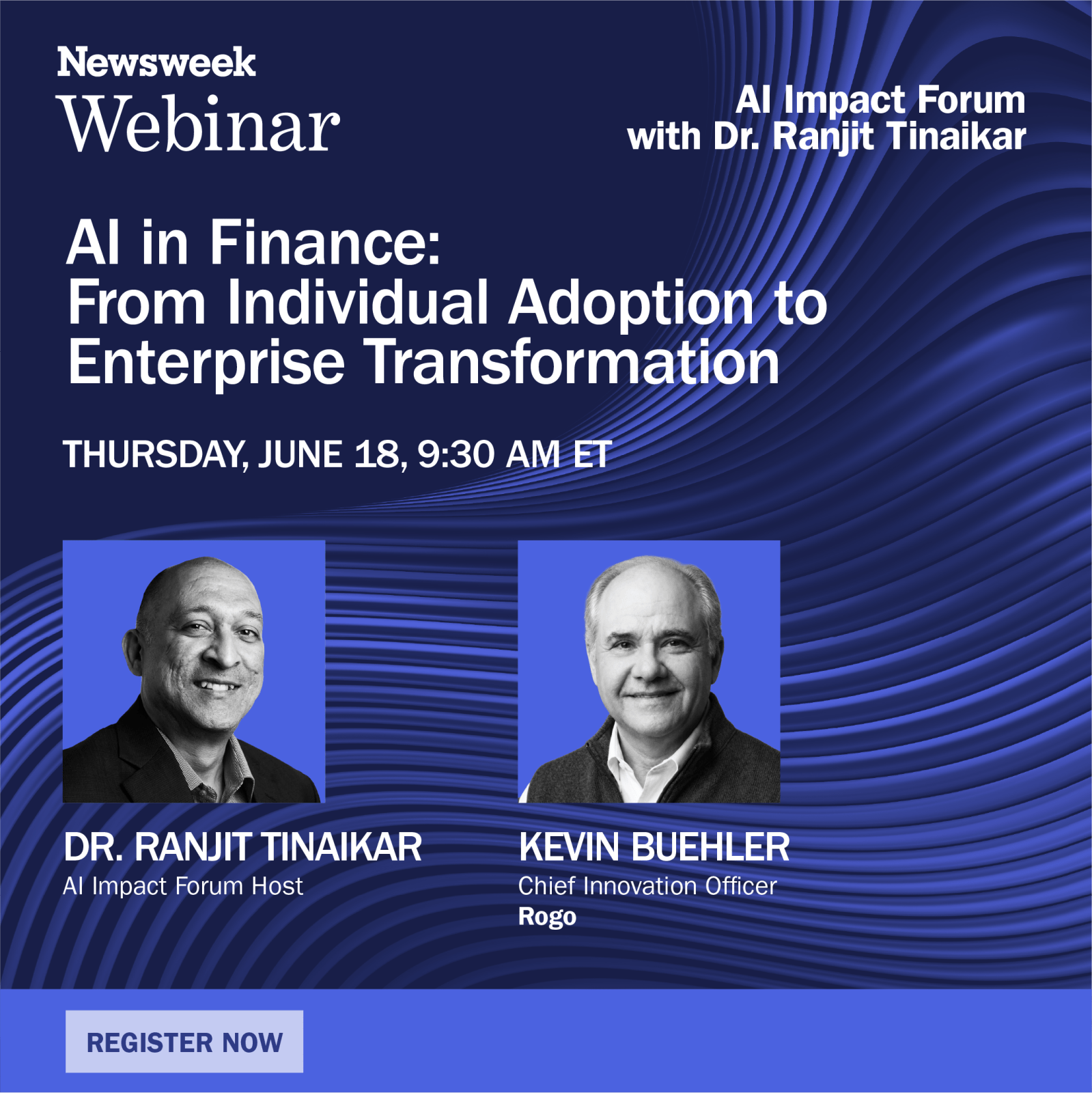
New AI tools are enhancing how financial professionals conduct research, analysis, create presentations, and manage client interactions with increased efficiency. The critical factor is how firms leverage this capability. Kevin Buehler, chief innovation officer at Rogo and senior partner emeritus at McKinsey & Company, questions whether firms will utilize AI to manage more clients, analyze additional markets, and focus on complex decision-making tasks.
The forthcoming Newsweek webinar, “AI in Finance: From Individual Adoption to Enterprise Transformation,” scheduled for Thursday, June 18, at 9:30 a.m. Eastern, will explore these topics. Hosted by Dr. Ranjit Tinaikar, the session will feature a dialogue with Buehler about how agentic AI could transform financial services and impact professionals such as analysts, investors, and software companies.
Buehler highlights AI’s significant impact on junior professionals, particularly in tasks connected to PowerPoint, Excel, communications, and analysis. He notes the rise of agentic AI significantly enhances performance at the foundational level. However, individual adoption represents only the initial step.
The potential for greater transformation lies in applying AI across entire business processes rather than isolated tasks. Buehler cites examples like client onboarding, mergers and acquisitions transactions, and lending as complex financial workflows that AI could fundamentally reshape.
“How do you use AI to take a process like that and really transform it?”
Job roles and allocation of AI-generated time gains form part of the ongoing discussion. Buehler emphasizes it’s not simply about replacing jobs with AI. Instead, the focus shifts to how financial institutions choose to redeploy the time and resources AI provides. Options include pursuing cost savings, expanding client services, or enhancing training for junior employees.
Buehler categorizes AI adoption into three primary phases. The first involves AI use at junior levels, supporting analysts and associates in streamlining tasks. The second stage involves senior management, like managing directors, employing AI consistently and adapting to AI-assisted team management. The third is a comprehensive redesign of workflows.
Most firms have yet to achieve this final stage. Advancing requires an economically-driven plan, strong leadership, improved data management, talent development, and effective change management. As Buehler notes, data often presents a significant challenge in these initiatives. Upskilling and reskilling existing talent is essential, as simply hiring new personnel isn’t a feasible solution.
The June 18 session will further connect how adoption impacts broader financial economics. It will cover the value of human involvement and enterprise-specific context, potential for domain-specific applications, and evolving commercial models as AI systems progressively perform tasks.
The competitive advantage might hinge on whether AI evolves from a personal tool into an integral part of business operations. Buehler remarks that many firms are still at the beginning stages of this transition. Register for the webinar at no cost to learn more.