NASA’s Bold Mission to Save the Swift Telescope
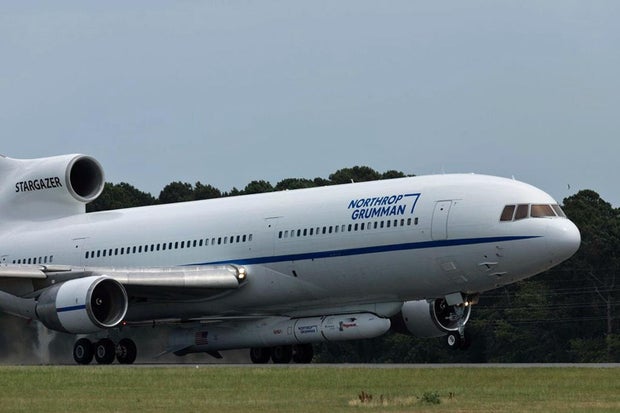
By July 3, 2026, a small company in collaboration with NASA and Northrop Grumman embarked on a daring mission to salvage the Neil Gehrels Swift Observatory. The objective was to prevent the $250 million space telescope from burning up upon re-entering the Earth’s atmosphere. This effort aims to provide the telescope with continued life in its role of detecting violent cosmic explosions.
Mission Overview
Northrop Grumman utilized its last operational L-1011 transport plane, known as the ‘Stargazer,’ to launch the Pegasus XL rocket with Katalyst Space’s LINK space tug. The mission, delayed three days due to adverse weather and software issues, succeeded when the LINK satellite was released and entered orbit. Initial checks confirmed that the satellite’s solar arrays deployed correctly, setting the stage for a detailed flight system inspection.
The LINK space tug will use its three robotic arms to attach to the Swift Observatory, employing low-power ion thrusters to lift the telescope to an orbit of about 370 miles. This reboost is essential to extend Swift’s mission by an estimated decade, taking around 10 to 12 weeks to achieve.
The Importance of Swift
The Swift space telescope, launched in 2004, was designed to detect gamma-ray bursts, the universe’s most potent explosions. These occur when massive stars undergo a supernova, forming black holes or colliding neutron stars. Since its launch, Swift has detected over 2,000 such sources, providing crucial data that enhances our understanding of cosmic phenomena.
Gamma-ray bursts unleash immense energy briefly, emitting more energy in seconds than the sun will during its entire life span. The observatory’s contributions to confirming how heavy elements form emphasize its significance.
The Challenge of Satellite Maintenance
Without intervention, Swift’s orbit would decay due to atmospheric drag, ultimately leading to its destruction upon re-entry. Katalyst Space developed the LINK spacecraft rapidly, with its build completed in just eight months. This mission not only saves a valuable scientific tool but also demonstrates technologies for future satellite maintenance.
Advancements in satellite servicing and rescue could make it feasible to maintain and extend the lifespans of existing satellites. Katalyst aims to refuel, repair, and service high-value satellites. These efforts might even support missions to preserve other aging telescopes like the Hubble.
Future Prospects
Katalyst Space envisions a shift from a disposable mindset to a sustainable approach in satellite management. The ability to reposition, refuel, and upgrade satellites could revolutionize space operations. As these technologies develop, the potential exists to prevent many critical satellites from premature obsolescence, preserving their utility and enhancing their contributions to science.
This effort not only showcases technological innovation but also represents a shift towards sustainable space exploration practices that maximize existing investments.