Political Struggles Over School Voucher Program in West Virginia
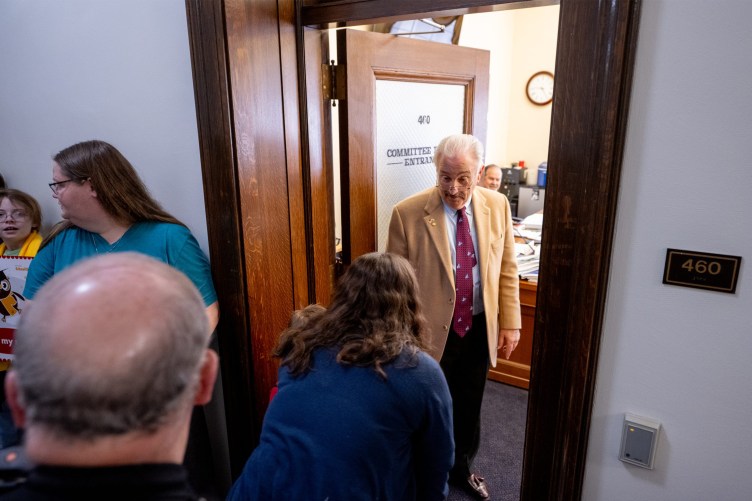
On a chilly February morning in West Virginia’s Capitol, crowded hallways bore witness to the tensions surrounding the state’s education system. Children with winter jackets held signs and homework outside the House Finance Committee room, expressing the discontent over proposed changes to the Hope Scholarship program.
Delegate Vernon Criss, chair of the committee, faced a wave of opposition. He had suggested limiting payouts from the voucher program, raising concerns from families and lobbyists who claimed the proposal threatened the program’s existence. Criss, a Republican, had voted to establish the Hope Scholarship five years earlier, alongside similar legislation in 11 states.
Initially costing West Virginia $9 million, the program expanded rapidly, with projections suggesting it could cost $200 million annually by 2026. Criss feared the unchecked growth of the program, coupled with tax cuts, might harm the state budget.
“We need to face the music,” Criss stated, signaling the need for fiscal responsibility.
As parents, media, and children gathered in the committee room, Criss announced the bill wouldn’t be discussed that day, prompting parents to leave. Days later, efforts to restrict voucher spending were halted, with Criss facing political challenges.
The opposition traced back to strong “school choice” advocates, organizing at both local and national levels. When Republicans seized control of West Virginia’s Legislature in 2015, school choice emerged as a key focus. Through lobbying and backing supportive lawmakers, groups established the Hope Scholarship six years later.
The program’s first year saw over 2,300 students enrolled, promising more participants over time. In 2026, 26,000 students enrolled—a number exceeding West Virginia’s largest public school district.
Prominent figures like the Koch family network and billionaire Jeffrey Yass supported these initiatives, funding private education nationwide. Competing interests led to intense resistance to any proposed limits.
Three political action committees heavily targeted Republican incumbents during the 2026 West Virginia primary, ousting four, including Criss. Among the PACs, Koch-related groups and ones Yass contributed to played significant roles. The School Freedom Fund and Sugar Maple PAC, with substantial backing, succeeded in unseating Criss.
David McIntosh, leading the School Freedom Fund, reflected on the outcomes: “These elections are a warning to Republican leaders like Vernon Criss—oppose school freedom, expect accountability.”
As ProPublica researched education dynamics, questions arose about finding schools and navigating voucher-style programs. Across the U.S., families confronted challenges navigating educational options amid shifting policies.
Criss, previously uncontested in his 2024 primary, faced an uphill battle in 2026, with PACs spending over $145,000 to support his 23-year-old opponent. The proposed financial limits for the Hope Scholarship emerged amid dwindling public school funding. Since 2019, 70 schools closed, losing over 30,000 students, with more closures anticipated.
During the same legislative session, emergency measures for struggling districts unfolded quietly, contrasting with the loud battles over voucher programs.
The Rise of Hope
In 2021, as the Hope Scholarship was crafted, external assistance shaped its creation. Jason Huffman, a political operative with Americans for Prosperity-West Virginia, played a notable role. The organization, formed by billionaire donor David Koch, sought low taxes, school choice, and relaxed environmental rules nationwide.
As Huffman shared, the goal was creating a universal school voucher, later inspiring similar programs in other states. Collaboration with local entities like the Cardinal Institute further bolstered these efforts.
Founded in 2015, Cardinal focused on public funding for private education as a key policy, with donations from Koch-connected groups enhancing their resources. Partnering with Americans for Prosperity and the Institute for Justice, they sculpted the initiative.
“I just felt like this doesn’t feel good to send my nonverbal child to a school that isn’t collaborative,” said Katie Switzer, highlighting her advocacy for alternatives to public school.
Switzer’s story became an emblem of the push for the Hope Scholarship, as she navigated court challenges and supported the cause widely.
Opponents argued the scholarship drained funds from public schools, winning support from the state Board of Education. On the opposing side, West Virginia Attorney General Patrick Morrisey fought to uphold the law.
The Institute for Justice enlisted Switzer and another parent, enabling their defense of the scholarship in court. Financing from Yass-powered charities underpinned their battle, culminating in the West Virginia Supreme Court’s endorsement.
Morrisey, gearing up for a gubernatorial run, benefited from support like Club for Growth Action, heavily funded by Yass.
Runaway Train
In January 2025, Morrisey donned his coat, delivered his inaugural address, calling for Hope Scholarship expansions, empowering parental choice in education.
This year, before Morrisey’s State of the State speech, the House Education Committee reviewed a report from the Rand Corporation. The report highlighted state education concerns, urging cap placements on scholarship awards and boosting public school funding.
While Criss’ Finance Committee wrestled with Hope Scholarship expenses, Criss found solutions. Capping awards and refining expenses could sustain the program long-term. Yet, families rallied against his plan.
Switzer, advising on practical matters, warned that caps endangered the program, urging concern for 19,000 children impacted.
Huffman amplified their fears, taking messages to radio and social media. Criss’ proposal intended sustainability, but faced opposition declaring caps eroded program viability over time.
Political forces stirred responses, with Criss noting resistance due to the scholarship being a “giveaway program.” With election season nearing, hopeful families and groups remembered the scholarship battle.
Beyond education concerns, campaigns targeted broader issues. Criss faced ads labeling him liberal, erroneously claiming he advocated open borders and drag queen support. Attack mailers protruding claims surrounding immigration and reproductive rights engulfed his campaign.
School Freedom Fund funneled nearly $1 million into legislative races, targeting figures like Criss. Americans for Prosperity targeted similarly, investing approximately $700,000 across the state.
Prominent figures, like the governor, welcomed organizations sharing similar ideals and educational goals for West Virginia.
Although Criss now seeks reinstatement via a write-in campaign, the political forces and backing behind his primary defeat leaves his political future uncertain.