Secretary of State Marco Rubio’s Timely Visit to India Amid Diplomatic Challenges
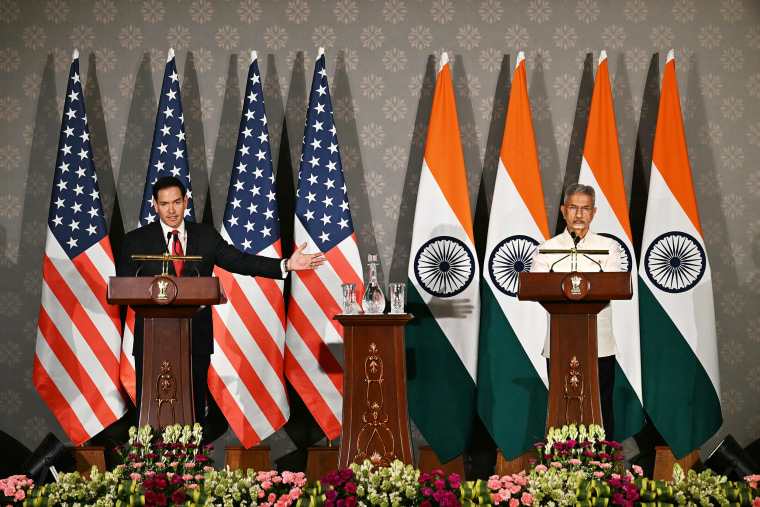
Summers in New Delhi are harsh, even for Floridians accustomed to heat. Secretary of State Marco Rubio felt this first-hand upon his arrival in India over the weekend, facing temperatures exceeding 100 degrees. His four-day visit included significant meetings with Indian Prime Minister Narendra Modi, foreign ministers of India, Australia, and Japan, along with a midday tour of the Taj Mahal. The heat drew concern from social media users worried about Rubio’s endurance.
Speaking at the inauguration of the U.S. Embassy’s new building in New Delhi, Rubio humorously acknowledged the intense heat. “I wanted to keep this brief because it’s hot,” he said, comparing it to the humid heat of Miami. Despite the challenging temperatures, his visit held substantial diplomatic significance.
Rubio’s discussions with Indian Foreign Minister Subrahmanyam Jaishankar occurred at a pivotal time for the Quad, known as the Quadrilateral Security Dialogue. The relations between the U.S. and India have encountered strains recently, primarily due to the Trump administration’s tariffs on Indian exports. Although an interim trade agreement was reached, disputes over energy persist. Washington’s interactions with Pakistan, especially concerning the Iran conflict, have heightened concerns in New Delhi, considering Islamabad’s links to terrorism.
On Tuesday, Rubio highlighted productive meetings with his Quad counterparts, announcing initiatives focused on maritime surveillance, port infrastructure, and critical minerals. “Current events remind us of the importance of maritime security,” Rubio stated, noting the Indo-Pacific’s role in handling 60% of global maritime trade.
China responded to these developments, with Foreign Ministry spokesperson Mao Ning emphasizing that cooperation should not target any third party. Ning cautioned against undermining mutual trust in the region.
On Monday, Rubio and his wife, Jeanette, toured the Amber Fort in Jaipur, known for its historic forts and palaces, although it offered no relief from the heat. They also visited Mother Teresa’s resting place in Kolkata and posed for pictures at the Taj Mahal.
The intense heat in India was a topic on social media, with users describing it as “hellishly hot,” and some sarcastically suggesting a raise for the visit’s scheduler. Rubio’s appearance at the Taj Mahal resonated with many Indians grappling with the heat, exacerbated by rising fuel prices due to disruptions in oil imports from the Gulf.
Rubio discussed the Iran conflict, advocating for reopening the Strait of Hormuz, which could form part of a potential Washington-Tehran agreement. Despite the conditions, Rubio expressed optimism about U.S.-India relations, emphasizing the opportunities for collaboration, and highlighted a pact on critical minerals and rare earth supply chains signed between the two nations.
The Quad’s joint statement underscored a strong opposition to destabilizing actions that threaten regional stability, with implicit concerns about China, especially regarding the South China Sea. Rubio’s tour included a visit to an Indian children’s home, illustrating his diplomatic engagements.
Following his India visit, Rubio proceeded to Yerevan, Armenia, to meet Foreign Minister Ararat Mirzoyan for a signing ceremony. Armenia, reliant on Russia for energy, is gradually diversifying its alliances.