The Military’s Response on 9/11
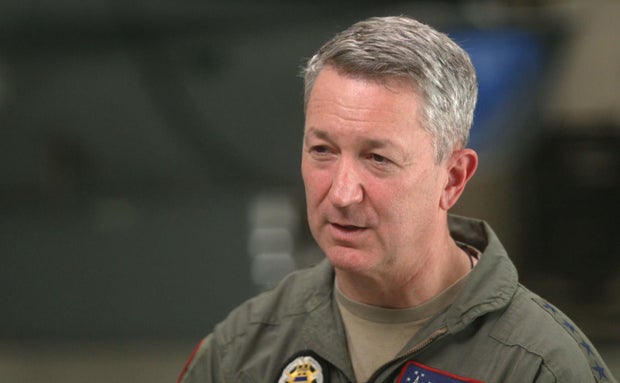
Thousands of first responders and emergency workers rushed to Ground Zero on 9/11. Meanwhile, America’s military quickly leapt into action. General Dan Caine, the Chairman of the Joint Chiefs of Staff, was the chief of Weapons and Tactics for the 121st Fighter Squadron at Andrews Air Force Base in Maryland. On that day, he attended a scheduling meeting when a young staffer reported that a plane had struck the North Tower of the World Trade Center. He and his colleagues then watched as the second plane hit the South Tower at 9:03 a.m.
“I still remember what I felt and thought watching the news helicopter film the burning tower,” Caine said. “When the second airplane hit, I knew our nation was under attack.”
Caine said there was “no doubt” the country was at war. His squadron began preparations immediately. Orders were given to mobilize the base’s weapons, including air-to-air missiles. Smoky skies from the Pentagon could be seen on the horizon, and Caine received a call from the White House to scramble defenses for Washington, D.C. He described the rules of engagement as “very liberal.”
The squadron received instructions to intercept United Flight 93, which hijackers planned to fly into a federal building in Washington, D.C. before crashing in a Pennsylvania field.
“They put the responsibility on us,” Caine said. “Our wing commander, Brigadier General Dave Wherley, said ‘Dan, I trust you to do the right thing.'”
Some planes launched without being armed with missiles due to time constraints. Squadron operations officer Lt. Col. Mark Sasseville and wingman Heather Penney were among those pilots. Both later noted that they had planned to ram their aircraft into the plane, a maneuver that would have been fatal.
“In the military, we don’t send our service members on suicide missions,” Penney said. “But it was clear what needed to be done that morning.”
Caine’s aircraft, loaded with live missiles, took off with an understanding that shooting down a commercial airliner might be necessary. All flights over Washington, D.C. were stopped, and any refusals would be shot down.
“I remember thinking, ‘That’s me doing the shooting.’ My prayer was, ‘Dear God, please don’t let me screw this up.’ My job was to think through chaos, remain calm, and protect the country,” Caine remarked.
Ultimately, Caine did not have to fire. Passengers on United Flight 93 stormed the cockpit and crashed the plane, preventing any direct hit on Washington, D.C. Caine praised their bravery.
“We take an oath to protect the United States. They boarded an airliner and were the first to fight back on September 11,” Caine said.
He also commended emergency workers at the crash sites, noting the courage shown on that day. The events of 9/11 remain impactful to Caine even 25 years later.
“I don’t think I understood service until September 11,” Caine reflected. “I was a young fighter pilot who thought flying jets was cool until it got real. The courage and patriotism shown by Americans that day remain a gift.”