The Nightly Task of Documenting Congress
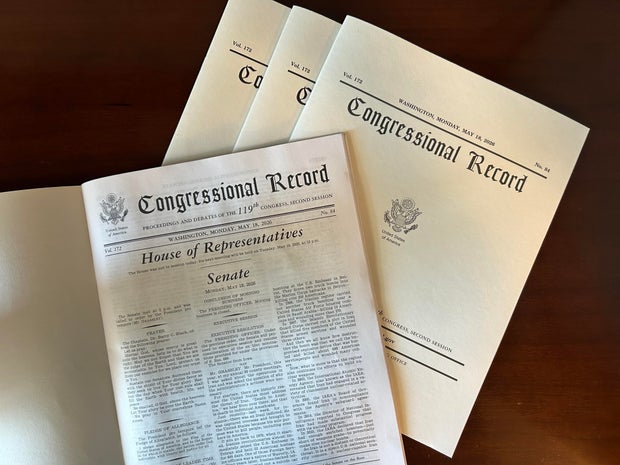
Washington, D.C. — Inside a red-brick building near the Capitol, workers engage in a nightly ritual that captures the essence of congressional proceedings, producing the Congressional Record. This document serves as the definitive source of the daily activities of both the House and Senate.
The Government Publishing Office (GPO), charged since 1873 with printing the Record, occupies a cavernous space with high ceilings in Washington, D.C. The room houses industrial-size printers that churn out large rolls of paper filled with details of legislative debates and actions.
Documenting Congressional Proceedings
Words spoken on the Senate and House floors are meticulously recorded, even as the rest of the city sleeps. The final product is delivered much like a newspaper each day, providing a detailed chronicle of congressional activity.
Before the Congressional Record’s inception, the inner workings of Congress were less accessible. Limited newspaper reports offered fragmented coverage, leaving room for error and partisan bias. It wasn’t until March 5, 1873, that the GPO published the first formal Congressional Record.
“There was definitely a demand for what was going on on the floor of Congress,” said Daniel Holt, an associate Senate historian. “The problem was that there wasn’t a mechanism in place.”
Lyndon B. Johnson, as Senate majority leader, underscored the role of the Record in shaping laws and precedents, highlighting the significance of its comprehensive account of congressional dialogue.
The Creation Process
Floor reporters capture every word spoken, rotating in shifts to maintain accuracy. Their shorthand notes are transformed into polished documents through a series of editing rounds. Transcripts are combined with vote counts and committee reports before being sent to the GPO.
The Record is printed on 11 x 8.5 inch pages, with content arranged in three columns. Its length varies based on congressional activity, ranging from 22 pages on recess days to 233 pages when Congress is in full session.
Editing occurs back at the Capitol, after which stacks of paper are hand-carried to the GPO. Here, discrepancies between digital and paper copies are resolved in favor of paper, as highlighted by GPO Director Hugh Halpern.
Proofreaders at the GPO meticulously review the material, ensuring adherence to intricate formatting rules. They mark up pages and correct errors in a newsroom-like setting that operates around the clock.
Printing and Distribution
The actual printing takes place in an expansive area once designed for rotary presses. Modern inkjet technology requires fewer personnel but maintains high efficiency. Finished copies of the Record are prepared for delivery, primarily to libraries, institutions, and Capitol Hill.
Although the Record’s print circulation has decreased to about 1,500 copies daily, digital versions are available through govinfo.gov. The agency’s digital transition allows broader access to legislative documents.
Future Considerations
Halpern acknowledges the need for continual evolution. Though conversations about technology like AI are ongoing, trained human proofreaders remain irreplaceable for ensuring accuracy.
“Eventually, I would love to see a tool that’s sort of like Grammarly on steroids, that can cut out some of the more routine work,” Halpern said.
As the GPO adapts to modern demands, it aims to envision the future of the Congressional Record, staying prepared for changes in congressional needs.