The Political Journey of Barney Frank
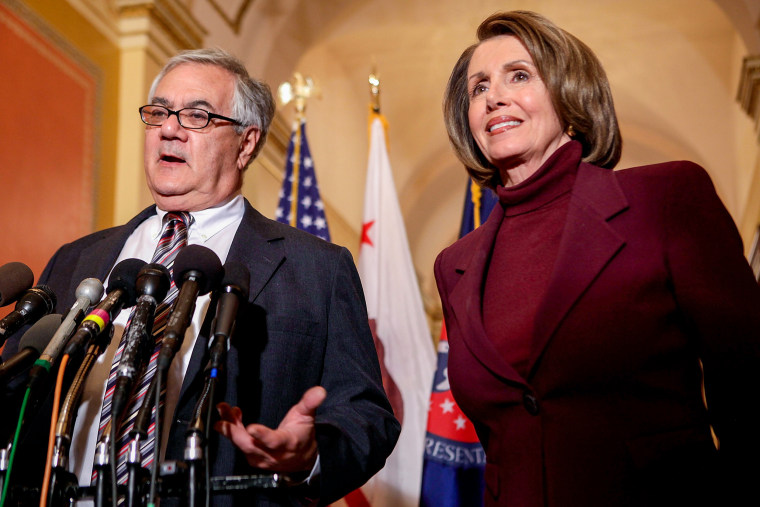
Barney Frank’s political journey began with his role as chief of staff to Democratic Boston Mayor Kevin White from 1968 to 1971, a period marked by significant racial tensions in the city. He then worked as a staff assistant for Rep. Michael F. Harrington, a Democrat representing Massachusetts’ 6th Congressional District.
In 1972, Frank ventured into electoral politics, securing an open seat in the Massachusetts Legislature. During his time in the state House, he earned a J.D. from Harvard Law School. In 1980, Frank advanced his political career by winning a seat in the U.S. House, representing Massachusetts’s 4th Congressional District with nearly 52% of the vote. Although his first election was tightly contested, he won his subsequent 15 re-election campaigns with ease, establishing himself as a liberal mainstay.
In 1987, during his fourth term in the U.S. House, Frank became the first member of Congress to voluntarily declare his homosexuality. He told The Boston Globe, “If you ask the direct question: ‘Are you gay?’ the answer is yes. So what?” He expressed that his sexual orientation was irrelevant to his job.
In 1989, Frank’s career faced a challenge when a news report surfaced about his relationship with Steve Gobie, a male sex worker and his personal aide. Frank admitted to paying Gobie for sex but terminated him after learning Gobie used Frank’s apartment for a prostitution service. In 1990, the House reprimanded Frank with a 408-18 vote for fixing Gobie’s parking tickets. Despite this, Frank retained strong support, winning re-election with 66% of the vote that year.
Throughout his three-decade career in Congress, Frank championed liberal causes, advocating for abortion rights, environmental protection, anti-discrimination, and LGBTQ equality. He was a strong proponent of repealing the military’s “don’t ask, don’t tell” policy. Mary Bonauto from GLAD Law praised Frank’s fearless approach, recognizing his advocacy extended beyond LGBTQ rights to women and people of color.
Frank’s legislative achievements include co-authoring the Dodd–Frank Wall Street Reform and Consumer Protection Act. A response to the 2008 financial crisis, the bill aimed to stabilize markets and protect consumers. Despite criticism from both sides, it remained a significant legislative accomplishment.
Frank faced criticism for supporting Fannie Mae and Freddie Mac, which played a role in the housing crisis. In 2010, he faced a challenge from Republican Sean Bielat but won with a lesser margin (54%) than usual. He chose not to run in 2012 and was succeeded by Democrat Joe Kennedy III.
In 2012, Frank married Jim Ready, reflecting on his married life as “nice” in an interview. He published an autobiography, “Frank: A Life in Politics from the Great Society to Same-Sex Marriage,” in 2015. On the day the Supreme Court legalized same-sex marriage in the Obergefell v. Hodges decision, Frank celebrated on social media. He is survived by his spouse, Jim Ready, his sister Ann Lewis, and his brother David Frank.