A Mother’s Journey from a Routine Illness to a Life-Saving Transplant
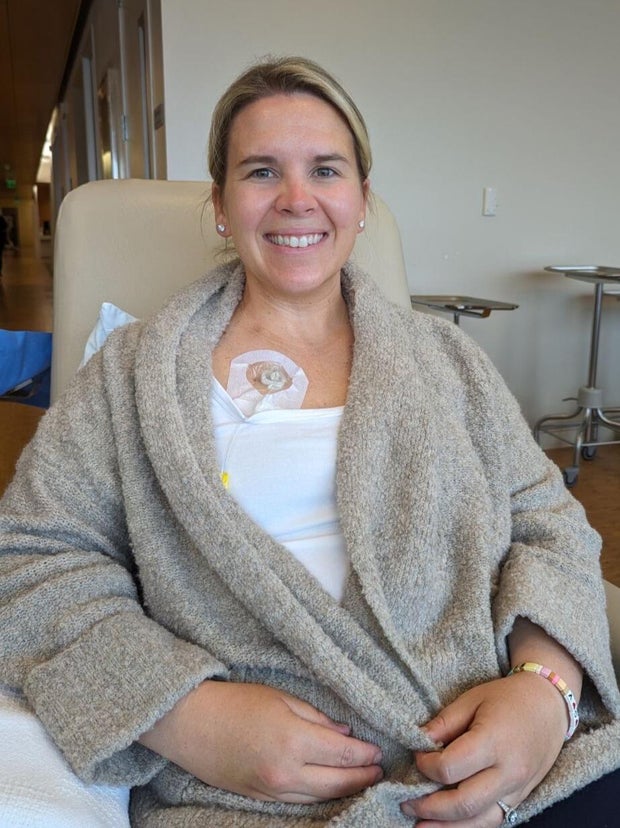
In May 2024, Amy Piccoli’s son contracted a stomach virus. Used to seasonal bugs, the Los Angeles mother of three didn’t think much of it. Predictably, she too fell ill. Unexpectedly, she became severely dehydrated and found herself in the ER.
Doctors conducted a CT scan that revealed spots on her liver and a mass in her colon. An MRI and subsequent biopsy followed. Piccoli recalled the moment of shock when her doctor relayed the news: “We think the liver spots are cancer that has spread from the colon.” Diagnosed with Stage IV colon cancer, she had no symptoms or family history, making the news even more jarring.
An Unexpected and Rare Diagnosis
Colon cancer typically presents symptoms such as gastrointestinal issues, blood in stool, and unexplained weight loss. Dr. Robin Mendelsohn, a gastroenterologist from Memorial Sloan Kettering Cancer Center, stated that Piccoli’s case—late-stage, symptomless diagnosis—is “extremely rare.” Piccoli started chemotherapy in June 2024. Genetic testing suggested immunotherapy could be effective, leading to significant tumor shrinkage and the removal of the colon tumor.
Exploring a New Treatment Option
Unfortunately, liver tumors remained inoperable. Piccoli learned about liver transplants for patients like her. Dr. Zachary Dietch from Northwestern Medicine shared that without additional treatment, her survival odds beyond five years were around 10%. However, European studies suggested that colon tumor removal coupled with a liver transplant could elevate survival rates to 80% for some patients.
The procedure has strict criteria. It demands a low recurrence risk, and no other disease beyond liver cancer. Only select patients qualify, explained Dr. Satish Nadig, director of Northwestern’s Comprehensive Transplant Center. Dubbed a treatment that “turns hospice into hope,” it is offered by few U.S. centers.
The Path to Transplant
In September 2025, Piccoli underwent evaluation at Northwestern. A family friend, Lauren Prior, matched as her donor. By December, Piccoli received her transplant. “I was just so excited,” Piccoli stated, viewing the surgery as the culmination of a lengthy, fear-filled journey.
Post-surgery, Piccoli remained in Chicago for three months, adapting to anti-rejection medication and undergoing routine scans. Separation from her family proved challenging, but necessary for her long-term health.
A Renewed Perspective on Life
By March, Piccoli returned home, continuing regular checks to catch any early signs of recurrence. According to Nadig, the risk is low, and recurrences typically occur in treatable, localized areas.
“It’s not a death sentence anymore,” Nadig reassured. For Piccoli, every test induces anxiety, but results have remained clear. She looks forward to a summer with her children, savoring life without the constant toll of treatments.
“Cancer changes your perspective,” Piccoli remarked. With this newfound outlook, she eagerly anticipates spending quality time with her family, free from the frequent hospital visits.
Edited by Kiki Intarasuwan