Data Centers Expansion and The Impact of Incentives and Public Concerns
Incentives for Data Centers
Data centers are expanding rapidly across the U.S. Some states are offering significant tax incentives to attract these projects. Washington and Texas are leading with the largest number of subsidized data centers. Good Jobs First’s database shows these states dominate the subsidy landscape, with Washington providing over 120 awards and Texas around 86. Other states, like Arizona and Utah, have fewer projects, while some, including Wisconsin and Georgia, have only a handful.
Interestingly, Indiana provided the largest subsidy package, estimated at $8.2 billion, benefiting Amazon Data Services. In 2023, Oregon offered $1 billion to Amazon. North Carolina provided Apple around $891 million in 2021. Meta and Microsoft also received large incentives, particularly in Texas and Georgia. Good Jobs First categorizes significant packages over $100 million as ‘megadeals’.
Where are Most Data Centers Located?
Several states are becoming key locations for data centers due to their unique advantages:
- Virginia: Known for its established cloud infrastructure.
- Texas: Offers inexpensive land and a deregulated energy market.
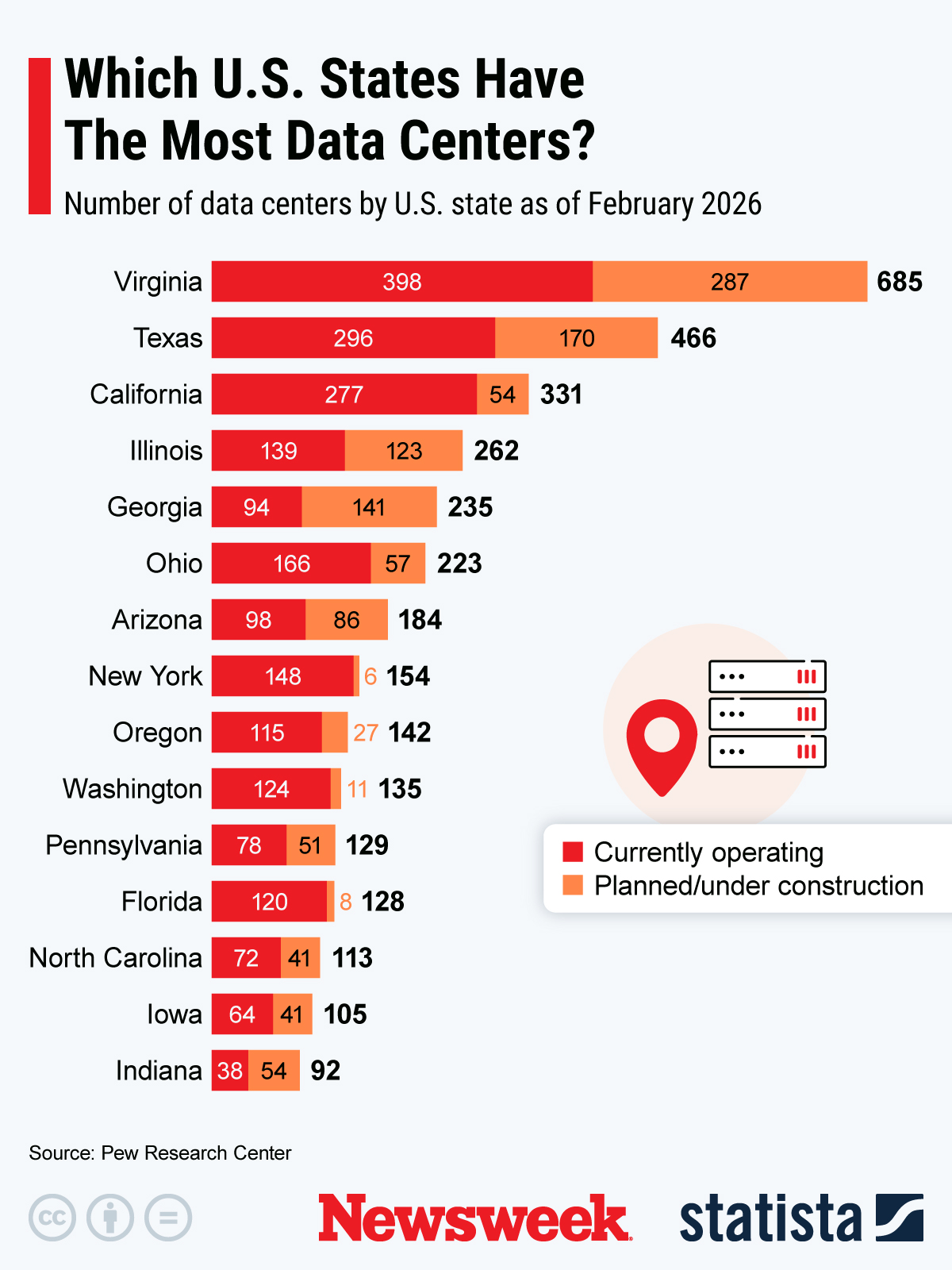
- California: Houses around 300 data centers by 2026.
- Ohio: Positioned as a Midwestern data hub.
- Arizona: Benefits from a favorable climate for cooling technologies.
- Georgia: Provides strong connectivity anchored by Atlanta.
- Utah: Offers lower real estate costs and access to renewable energy.
According to the World Resources Institute, these states represent nearly 60% of all data centers in the U.S.
Critics of Data Center Expansion
Environmental activist Erin Brockovich has been vocal against data center expansion. She launched a database tracking new constructions, documenting over 50 centers under development. Brockovich is known for her environmental advocacy, notably her case against PG&E in the 1990s.
Her initiative has garnered widespread attention, with over 6,600 people contacting her about AI data centers. Brockovich highlights public concern regarding energy-intensive facilities fueling the AI boom. On Facebook, she noted the growing number of submissions expressing concerns about the industry’s growth.
Reasons for Public Pushback
A Gallup Poll indicates significant opposition, with 70% of Americans against local AI data center construction. Participants expressed concerns about:
- Increased energy consumption and potential electricity costs.
- Water use impacting local supplies.
- Electronic waste from frequent hardware upgrades.
- Vulnerability to natural disasters and flooding.
- Pressure on local infrastructure and resources.
- Noise from cooling systems and generators.
The rapid industry growth fuels these concerns, particularly in areas with existing infrastructure strains.
Environmental Impact of Data Centers
Data centers significantly affect local energy grids, water systems and land use. Mid-sized centers can consume up to 300,000 gallons of water daily for cooling, while larger ones may use up to 5 million gallons. This water usage is equivalent to a town with a population between 10,000 and 50,000.
The increased energy demand raises pollution concerns, while land acquisitions for centers clash with agricultural and residential developments.