Federal Reserve Chairman Kevin Warsh’s Insights on Inflation and AI
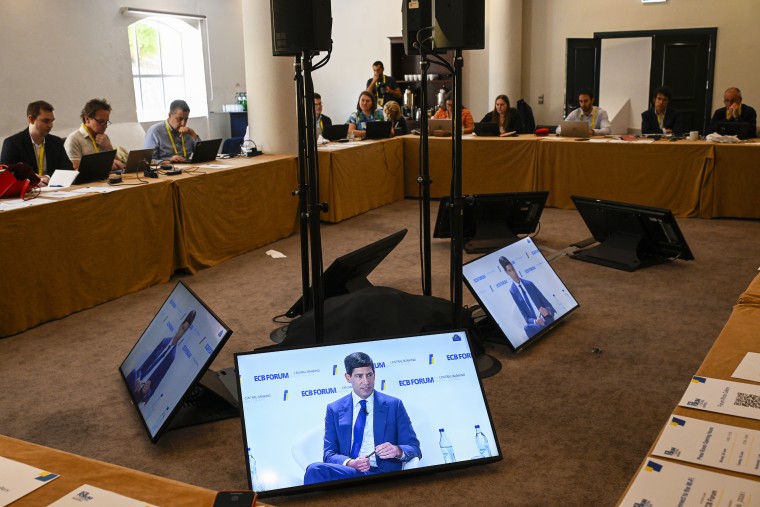
Federal Reserve Chairman Kevin Warsh remarked on Wednesday that, although inflation risks have decreased recently, the central bank still faces challenges in controlling rising prices. “Inflation risks have come down,” Warsh stated, noting a significant drop in energy prices since the United States and Iran signed a memorandum to cease the conflict last month. “They’re still a bit above where they were pre-conflict, but they’ve come down,” he added.
Currently, inflation is concerning for Americans, contributing to increased dissatisfaction with the economy according to polls and surveys. In May, the Consumer Price Index indicated a rise in inflation to 4.2%, the highest since 2023. The Fed’s preferred inflation metric also showed significant price growth, largely due to surging energy prices.
Warsh commented on the growing influence of artificial intelligence (AI) on the economy and inflation, expressing optimism about the technology’s long-term prospects. “We’re all being hit by a series of shocks in the U.S.,” he observed. “The AI shock is leading to a boom in capital expenditures. We see that first and foremost in demand, but I’m confident we’re going to see it in supply at some point. So we’re spending most of our time trying to monitor those developments.”
The central bank chief refrained from predicting future interest rate changes, saying, “I’m not going to give you any prediction as to what we will do.” Warsh plans to limit communications about the Fed’s future plans, breaking from previous Fed leaders’ approaches.
When asked about President Donald Trump’s stance on interest rates, Warsh responded, “We’ve been an independent central bank for a very long time. We’re going to be an independent central bank at this moment, and you’re going to see no changes on that.” Trump has pressed the Fed to reduce its key rate, previously criticizing Warsh’s predecessor, Jerome Powell, on the matter. Both Warsh and Powell were appointed by Trump.
Warsh was speaking in Sintra, Portugal, at the 2026 European Central Bank Forum on Central Banking. The event included high-profile figures like European Central Bank President Christine Lagarde, Bank of England Governor Andrew Bailey, and Bank of Canada Governor Tiff Macklem. Lagarde agreed with Warsh regarding inflation, mentioning the balance between inflation risks and economic growth prospects due to recent changes in energy prices.
The European Central Bank has raised rates since the conflict with Iran began, unlike the Federal Reserve, which has left rates unchanged while monitoring the inflation impact from energy. Warsh identified the AI industry as a key area of interest for the Fed.
Major tech companies, such as Microsoft, Meta, Alphabet, and Amazon, are aggressively building data centers globally to support new AI models, leading to rising costs for computer equipment and memory. As a result, companies in consumer electronics, like PlayStation and Xbox, have increased prices. Notably, Apple raised prices for many products including laptops, desktops, iPads, Apple TV devices, and HomePod speakers, but not for iPhones, Apple Watches, or AirPods. Analysts predict these products might see price hikes next.
Commenting on whether AI could be inflationary long-term, Warsh highlighted this as a central question for everyone involved. He predicted that the U.S. might benefit significantly in the medium term from AI advancements. “Who knew when the internet was born that the internet was going to create a million and a half jobs as Uber drivers? We are in the first or second inning of this,” he said. “This is a big paradigm shift, both for the conduct of our policy and for our economies,” Warsh continued. “I think the jobs will be greater, prosperity will be stronger.”
While AI could significantly affect employment, a study by Ramp showed companies investing more in AI are also increasing their workforce. Warsh reiterated the Fed’s comments following its last interest rate meeting, describing steady labor markets and a solid economic demand side. “But we’ve all looked around and we’ve seen that prices are too high, and I don’t think I’m the only one on this stage that’s recommitted to deliver price stability,” he said, referring to the Fed’s legal mandates.
In his first meeting as chairman last month, the Fed maintained interest rates, despite other policymakers projecting possible rate increases by year-end. Warsh downplayed these projections in a press conference. The Fed’s rate-setting committee plans to meet again on July 28 and 29.