Trump Calls for Expansion of Abraham Accords Amid U.S.-Iran Tensions
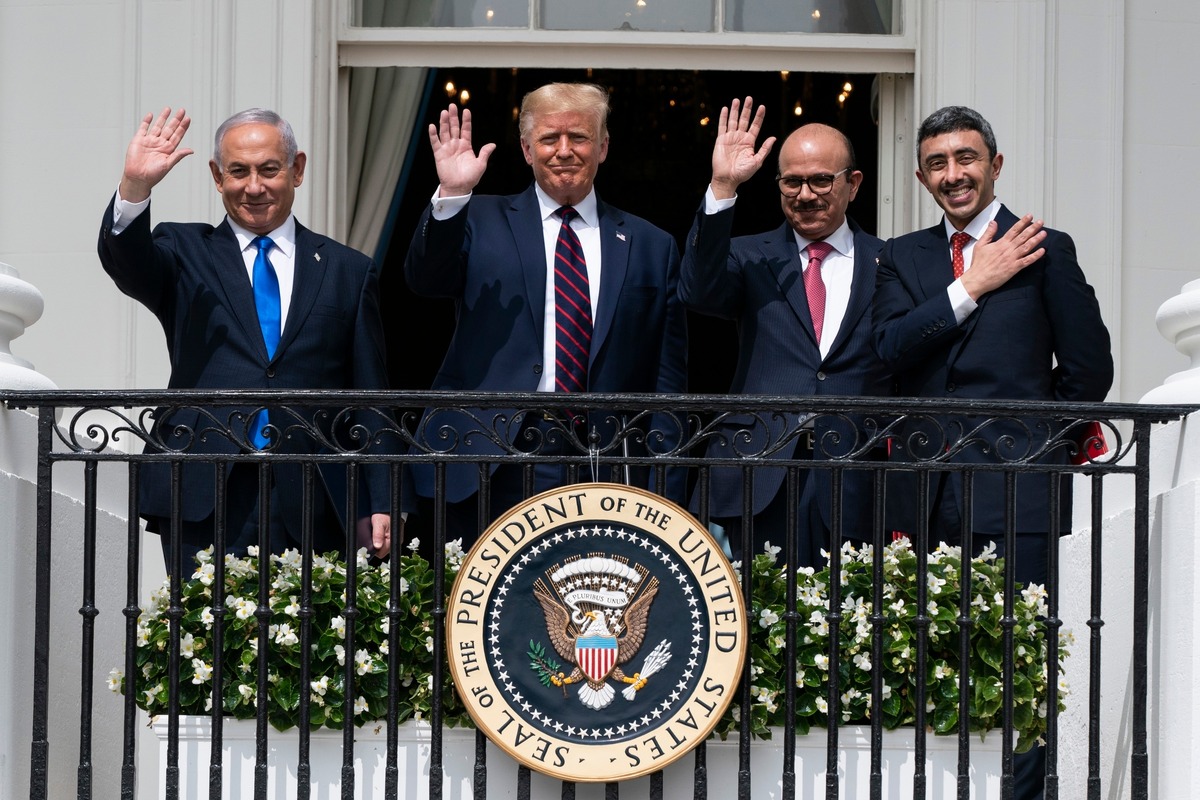
President Donald Trump has proposed that several Arab nations, alongside Pakistan and Turkey, should join the Abraham Accords as part of any peace agreement with Iran. This move may complicate the already challenging peace negotiations between the United States and Iran.
In a recent social media post, Trump stated it should be “mandatory” for countries like Saudi Arabia, the United Arab Emirates (UAE), Qatar, Pakistan, Turkey, Egypt, Jordan, and Bahrain to improve their relations with Israel. While the UAE and Bahrain are already participants in the Abraham Accords, Saudi Arabia has found it difficult to join due to its support for a Palestinian state. This stance was further challenged by the recent conflict in Gaza.
According to Trump, not all named nations need to join the Accords, but a majority should be willing to make the settlement with Iran more impactful. He has directed U.S. officials to encourage these countries to participate in the agreements.
U.S. Senator Lindsey Graham praised Trump’s statement as a profound change for the Middle East with historical implications.
The Abraham Accords, brokered by the U.S. during Trump’s presidency, normalized relations between Israel and several Arab countries. The agreements, referencing the biblical figure Abraham, are considered a significant achievement of Trump’s foreign policy.
The initial Accords were signed in 2020, with the UAE leading the way and Bahrain shortly after. Although Sudan agreed to normalize relations, political unrest has delayed official proceedings. Morocco joined in December 2020, while Kazakhstan joined in 2025, leveraging its historical relations with Israel to strengthen ties with the U.S.
Current U.S.-Iran Tensions
U.S. Secretary of State Marco Rubio indicated on Tuesday that any agreement with Iran might “take a few days.” This signals that a rapid resolution is unlikely as tensions have escalated recently.
Following recent U.S. strikes on Iranian positions, U.S. forces targeted missile installations and Iranian vessels. These actions, labeled as “self-defense strikes” by U.S. Central Command spokesperson Captain Tim Hawkins, were in response to Iran’s actions.
Reports indicate the U.S. sank Iranian ships and retaliated against missile attacks on its aircraft. These developments occurred after the U.S. targeted missile sites near Bandar Abbas, close to the critical Strait of Hormuz.
Iran’s Islamic Revolutionary Guard Corps (IRGC) expressed its right to retaliate against ceasefire violations. Sporadic exchanges have tested the ceasefire since April, creating uncertainty about the truce’s future. The IRGC reported shooting down a U.S. drone and engaging other aircraft in Iranian airspace. Brigadier General Abolfazl Shekarchi warned of severe consequences if new U.S. attacks occur, according to state media.